
You may have noticed that since Monday 3rd June, 2019 between the hours of 9pm and 10pm Sunday – Friday, the world seems a strangely quiet place. The answer to this lies in ITV2’s summer scheduling which importantly includes the return of love island.
For those of you unfamiliar with the show, the premise is simple: a load of single guys and a load of single girls get thrown into a villa together and are encouraged to forge romantic relationships for the entertainment of viewers. The nation relentlessly judges the authenticity of said relationships, and eventually one couple are crowned the winner of £50,000.
If, like me, you’re an avid watcher, then you might be familiar with the new terminology and phrases often inspired by the show – love island lingo, if you will. Previous series have seen the introduction of phrases like “my type on paper” (used to describe your perceived compatibility with somebody), “melt” (another way to describe a person, usually male, who dares to show their emotions) and “the ick” (a polite way of saying that you’re repulsed by another person).

Photo from Playpennies
This year, the phrase that’s on everybody’s lips is “it is what it is”. Originally uttered by Sherif, the phrase is often used in response to receiving, or expecting to receive bad news. For instance, upon hearing that his partner, Amber had “pied” (dumped) him for another contestant, Sherif resorted to the versatile phrase to express his feelings towards the situation.
Since it’s inception, the phrase has been used so often that the creators of love island have had to warn against viewers indulging in an “it is what it is” drinking game. As a keen fan of the show, hearing the phrase circa 143 times in the past two weeks got me thinking about what it means and the rhetoric that it might be portraying to viewers.
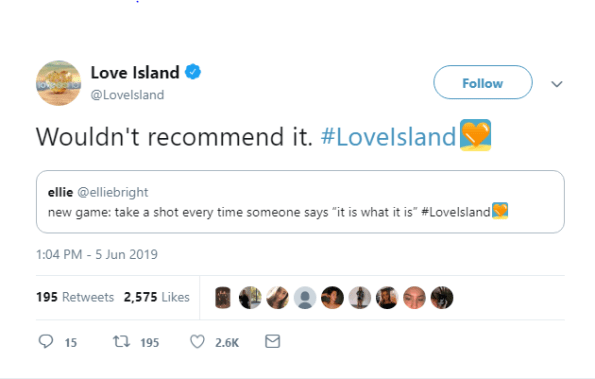
Photo from @LoveIsland Twitter account
A Wikipedia entry for the phrase describes it as “an idiomatic phrase, indicating the immutable nature of an object or circumstance”. The less diplomatic urban dictionary entry states: “Used often in the business world, this incredibly versatile phrase can be literally translated as ‘fuck it.’”.
For me, my initial response was that this was a phrase that suggested a particular attitude towards adversity, and encouraged a “pull yourself together and get over it” mentality.

Photo from @2019_Island Twitter account
It was only when I heard a participant in my PhD study use the exact same phrase that I realised the overlap between my academic area of passion and my television programme of choice.
My PhD aims to explore in more detail the notion of “alexithymia”. Translated from its origins, the term literally means “a” (a lack) “lexi” (of words) “thymia” (for feelings). The topic of my PhD was born out of conversations that my supervisor, Dr. Daniel Pratt, had with prisoners for whom he was providing cognitive behaviour suicide prevention as part of a randomised controlled trial. During therapy sessions, he found that when asked to explain their feelings, prisoners would simply state that they felt “shit”, and it was difficult to get any detail beyond this. This got him wondering if it was this difficulty to identify and communicate their feelings that might be the very reason for them feeling suicidal.

As such, my PhD aims to explore this relationship in more detail, and in addition, investigates the relationship between alexithymia and violence. So far, I’ve completed a systematic review, which supports the idea that experiencing alexithymia may indeed lead to somebody having thoughts of suicide, and to a lesser extent, attempting suicide.
I’ve also nearly finished collecting data for a qualitative interview study with prison staff which asks for their opinions and attitudes towards the role of alexithymia in prisoner suicide and violence. This is important, given that it is staff who are ultimately in a position to help reduce suicide and violence amongst prisoners.
Currently, I’m recruiting prisoners to both a cross-sectional and a qualitative study, and it was during one of my data collection sessions for the cross-sectional study that a participant stated “it is what it is” in relation to a recent suicide attempt. Whilst this is a very separate context to the way in which the phrase is thrown around the villa, it did get me thinking about the fact that it tends to be the male contestants that resort to the phrase most often, and whether this was in fact indicative of a deeper struggle with the communication, and maybe even identification, of emotions.
One theme that has come out of my staff qualitative study is a debate around whether prisoners are unable to communicate their emotions or whether they choose not to communicate their emotions. In prison, it’s fairly easy to understand why prisoners might choose not to share their emotions, as both prisoners and staff narratives centre around the need to ‘maintain status’, ‘fit in’ and ‘avoid showing weakness’. It got me wondering if the environment in the love island villa places similar pressures on the male contestants, and in doing so implies that this how all males should behave.
The one contestant this year who could be seen to break that mould, is Curtis Pritchard who tends to be quite forthcoming with his emotions (think becoming half-boyfriend and half-girlfriend within 9 days). However, this has led to debate over his sexuality, with the implication being that men who dare to show their emotions are somehow more likely to be gay.

Photo from @MassDeb8er Twitter account
Given that men tend to be at a higher risk of suicide than women, combined with the proclivity for men to conceal their feelings, it feels important to talk about the language of emotion we use in everyday life.
This year’s launch episode of love island bought in over 3.7 million viewers. Statistically speaking, 246,667 of these will make a suicide attempt at some point in their life. Let’s make sure that each of these viewers, male or female, knows that it’s okay not to be okay.
If you’ve been affected by any of the issues raised in this blog please seek further support:
Discover more from Research Hive
Subscribe to get the latest posts sent to your email.
 Research Hive