By Charlotte Criscuolo
The MRC DTP have recently hosted an online viewing of the film, Picture a Scientist. This film followed the lives of Prof Nancy Hopkins, Prof Jane Willenbring, and Dr Raychelle Burks, and their personal journeys of sexism in academia. From exclusion, gendered insults to sexual harassment. These struggles, small and large are faced by many women throughout their academic careers.
I found the film difficult to watch but insightful. It highlighted the little things that can happen day in and day out that we simply brush off. These things add up and can affect us in the long term.
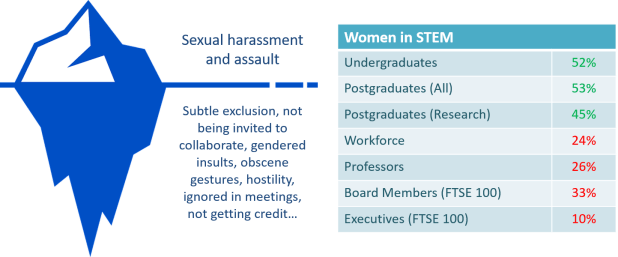
Iceberg of Academic Sexism // UK Women in STEM (statistics from WISE)
After watching the film a small group of us came together (virtually on Zoom) and discussed the impact and what we learnt from it:
- Acts of sexism have affected some of us here in Manchester.
- Gender discrimination can be so bad on a personal level.
- From a guy’s perspective (Jason), he didn’t realise how tough it could be and is now a lot more aware.
- That we all suffer in some way from our own unconscious gender bias (see IAT – implicit association test).
- Little things can add up, making a much larger issue.
- Whatever the impact is on white women, the struggle from BAME women is far, far worse.
- Change does happen.
We should highlight that the film did end on a positive and hopeful note. The landscape is changing and we even discussed what actions we all could take to help that process.
These included, forming networks to discuss these issues, trying to call out inappropriate behaviour and actions more, when we see them. We should show children what being a scientist really means (e.g. show more examples of women scientists, and additionally as a public engagement activity, ask children to describe and draw a scientist). We should encourage our female colleagues, rather than “pulling up the ladder” from them.
Another way we can help progress better representation in science is by actively seeking out female and BAME colleagues who can speak at conferences and keynote sessions. On a personal note, we talked about our own confidence, as we are often our own worst enemy. It might help to write and list out your achievements (small or big) to remind yourself how much you have actually succeeded already. Moreover, many of us are fortunate enough to be around some positive examples and changes already. We have multiple female PI’s and senior figures in our academic network, and they have inspired and supported us.
We as individuals or a community can inspire change in the system.
Finally, if you are interested in women in science feel free to access these resources:
- One million women in STEM, which aims to highlight the female role models and inspire young girls. (Link to be featured as a female role model or male advocate).
- Women in Science, a book describing the women pioneers in science and how they have changed the world.
- The Athena Swan award has been won by various departments in the University of Manchester and it is focused on equality and diversity for all.
I would like to thank Jade Talbot for making me aware of the film, without her input this interesting and inspiring event wouldn’t be able to take place.
Discover more from Research Hive
Subscribe to get the latest posts sent to your email.
 Research Hive