Author: Rojita Buddhacharya // Editors: Cherene de Bruyn & Emily Barrett
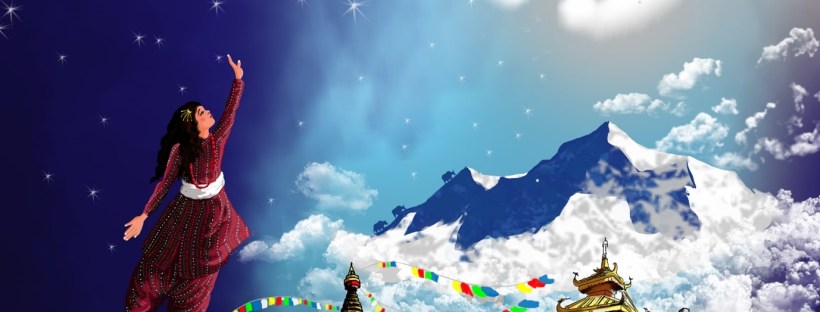
Cover image by Binita Buddhacharya.
If you imagine the Kathmandu Valley as a bowl, we live right at the centre, surrounded by hills and mountains. Standing at an altitude of 1,400 meters, Kathmandu’s residents are sometimes called “frogs in a well” – implying a limited worldview. People used to say that valley residents, especially those of my ethnicity, weren’t adventurers. Yet, who could have imagined that a girl from this “well” would be known nationwide as an explorer, conquer Everest and earn a Guinness World Record at the same time? But what does all this have to do with my PhD journey?
A Dream of the Moon Led Me to Everest
My journey began with loss. My mother passed away when I was barely two and a half, leaving me with no memory of her, not even an image. As the fifth daughter born to a family expecting a son, I grew up hearing that my arrival brought misfortune. Life became a series of battles against prejudice, but I was fiercely curious to know who my mother had been.
My grandfather, my only confidant, had a simple answer to my endless questions: he pointed to the moon and said, “If you want to see her, go there.” I stopped asking, but I started imagining – could I jump from house to house, then to the hills, and finally to the tallest mountain? From there, maybe I could leap to the moon and see her. This longing became my first dream, sparking an unstoppable curiosity about the cosmos. My quest to reach the moon evolved into a passion for space and exploration. I pursued astronomy, became a science journalist, interned at the Space Telescope Science Institute (USA), and even led an all-women journalists team to the summit of Mount Everest in 2018. Climbing Everest taught me resilience, perseverance, and self-discipline – qualities that sustain me on my PhD journey today.
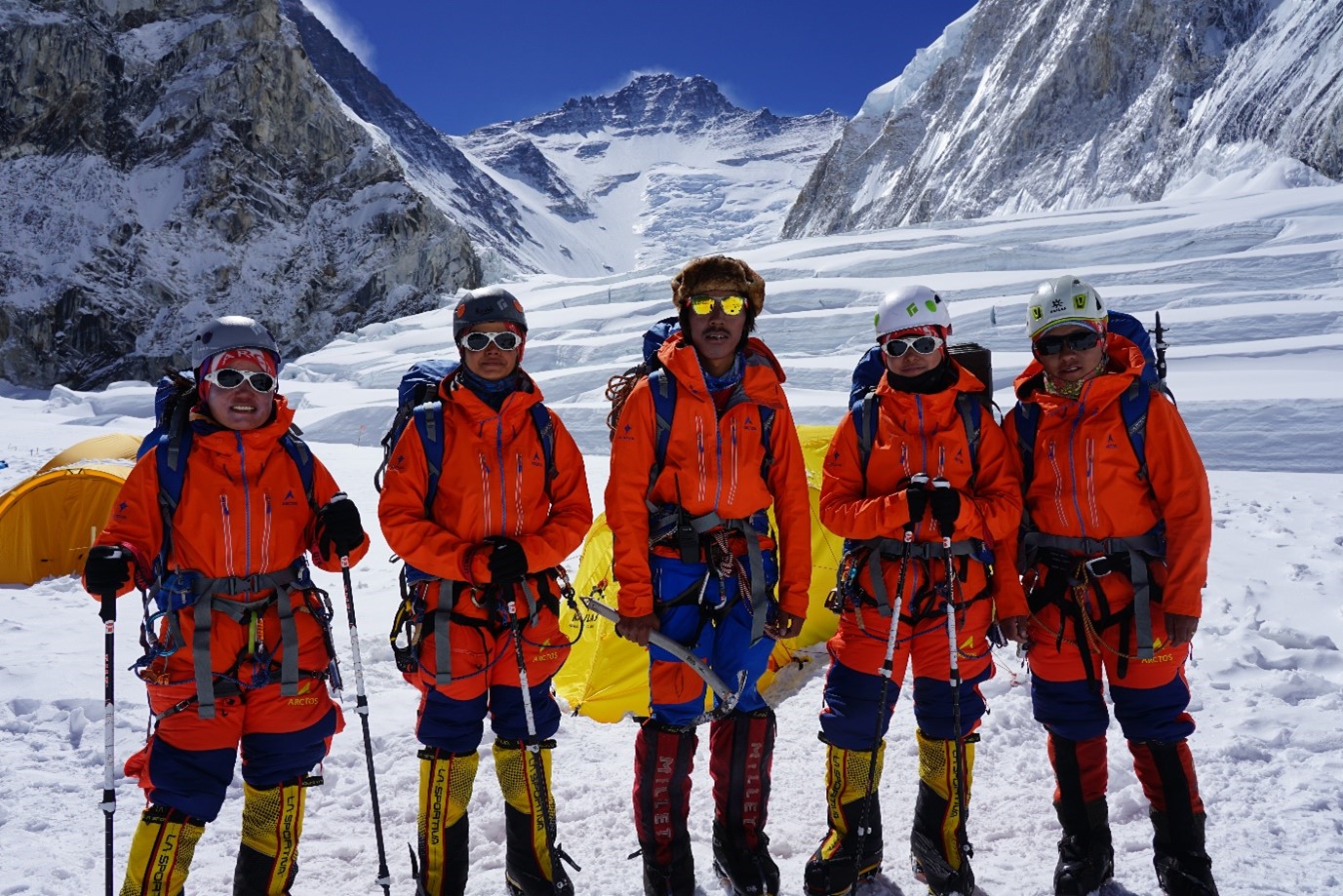
At camp 1 (6065 meters) of Mt. Everest with my ropemates. Picture Credit: Phurba Tenjing Sherpa & FWJEE18
Barriers Taller Than Everest
Life has never been easy. If I’m honest, I am not scared of external life obstacles, but of the inner battles I’ve had to face. Since childhood, I’ve heard people tell me what I “can’t” do because of my gender, background, or ethnicity. When I was young, even attending school was out of reach; education for girls was hardly a priority, and my family struggled to afford it. But my two older sisters fought for our right to learn, sacrificing their education and career so their younger siblings, including me, could go to school.
There was only one path to success for us: excellence. Scholarships were awarded only to top students, so we worked tirelessly to achieve the grades we needed. Eventually, I found ways to support myself – tutoring high school students and working as a journalist – even as I continued my full-time studies. Despite my achievements, I’ve always had to go above and beyond to prove my worth.
Let me share one of my most recent roadblocks since I started my PhD. Recently, during riots in the UK, I found myself in a state of real fear. As a foreign student, there’s a vulnerability that can feel heightened during such turbulent times, and it was difficult to navigate my sense of safety. When the local news became international news, my family back in Nepal urged me to return, reminding me that life is more important than any degree. Their words weighed heavily on me. I had worked my ass off with all my existence to be here today, yet there was a moment when all my dreams and aspirations crumbled before my eyes.
It wasn’t the only time I faced such questions. Moving to a new country and adjusting to an unfamiliar culture, while trying to keep up with the academic expectations of a PhD, sometimes felt overwhelming. There have been times when I’ve felt far from home in every sense — missing food, people, and cultural comforts that aren’t as easy to find in my new surroundings. I’ve questioned the sacrifices I’m making. Is it worth it to be so far from loved ones? Time is uncertain, after all. They won’t be here forever and I won’t be here forever.
In those moments of doubt, I kept coming back to the core motivation that started me on this journey. Conquering my self-doubt is more challenging than climbing Everest, but the same Everest taught me true resilience lies in pushing through internal struggles, redefining our limits, and remembering why we started. I am the architect of my own life and choices including my PhD journey, and if I do not follow my dreams, no one else will.
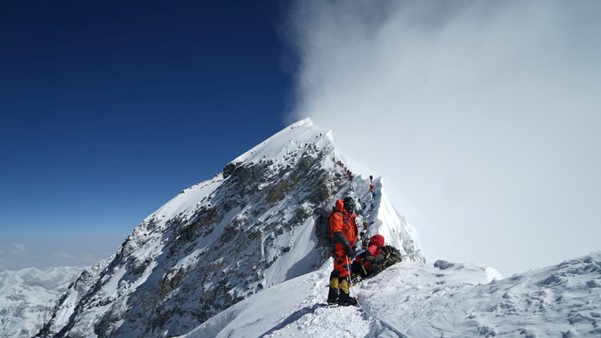
Me at Hillary Step (8790 meters) Picture Credit: Phurba Tenjing Sherpa
The Power of Support
The journey hasn’t been mine alone; I owe much to those who have supported me along the way. As my soul brothers in Italy say, “Teamwork makes the dream work.” I believe a good support system holds the pieces of my life together. My sisters, my mentors, and my supervisors have all been part of that support system, believing in me when I doubted myself.
My sisters would move mountains for us, and my mentors, like Dr. Nora Luetzgendorf, the lead scientist of the Laser Interferometer Space Antenna (LISA) at the European Space Agency (ESA, ESTEC), the Netherlands and Prof. Dr. Michele Trenti, Principal Investigator of SpIRIT Cubesat at the School of Physics, University of Melbourne, Australia showed me that I’m more than capable of achieving my dreams in astronomy. My supervisors have been a constant source of encouragement and understanding, helping me through both academic and personal challenges. I remember many conversations when I was feeling especially low, they reassured me that taking time to recalibrate and focus on my well-being was not only okay but essential for my PhD.
Whether it’s a late-night phone call to my family back home or words of encouragement from friends here in Liverpool, I’ve learned how essential it is to lean on others. Their encouragement has been a reminder that I’m not alone in this journey, and has been invaluable in maintaining my resolve. I am blessed to have a partner back home with whom I can be my unfiltered self, even in the moments when I feel at my most vulnerable. Someone with whom I can be the “little girl from Nepal” and sees me through moments of confusing distress.
Celebrating Progress and Resilience
Looking back, I feel proud of the progress I’ve made. I recently presented some preliminary findings from my ongoing research on star formation environments at the Milky Way’s centre at the UK Galactic Star Formation Conference in Armagh, Northern Ireland. The response was incredibly positive, with one senior scientist describing it as an “excellent talk.” Leading up to the conference, I felt nervous and anxious, as it was my first scientific conference talk. Achievements like these reassure me that I’m on the right path. This PhD journey, for me, isn’t just about research – it’s a test of grit, resilience, and the strength to overcome self-doubt.
I believe you feel the same. I’m learning to face setbacks without letting them define me, and I know each challenge makes me stronger. The small victories along the way remind me that my passion for the cosmos and my curiosity to find my mom (now in a philosophical way) are stronger than any roadblock.
Final Thoughts
For anyone considering a similar path, know that it’s okay to feel overwhelmed. There will be moments when the challenges seem insurmountable, especially for international students far from home. But remember why you started. Lean on your support system, and celebrate each milestone, no matter how small. In the end, this journey shapes you as much as your research will, and that’s something truly worth embracing.
And remember – at the core of it all, your self-belief and resilience are what will carry you forward. Let’s conquer our inner Everest together.
About the Author: I’m Rojita Buddhacharya (r.buddhacharya@2024.ljmu.ac.uk), a first-year PhD in Astrophysics at Astrophysics Research Institute in Liverpool John Moores University. My research focuses on ‘what controls star formation at the centre of Milky Way’. My project is part of a collaboration called ACES (ALMA CMZ Exploration Survey) which includes more than 100 astrophysicists across the globe. I am working with Dr. Jonathan Henshaw, Prof. Dr. Steve Longmore and Dr. Daniel Walker. My research is funded by the Bell Burnell Graduate Scholarship Fund (Bell Burnell Graduate Scholarship Fund Awardee 2023) and Liverpool John Moores University. I was born in Kathmandu, Nepal, a Himalayan nation home to Mount Everest, the world’s highest mountain.
Discover more from Research Hive
Subscribe to get the latest posts sent to your email.
 Research Hive