Author: Erin Pallott // Editors: Nithya Eswaran & Vicky McIntyre
I enjoy browsing social media under hashtags relating to my research fields. There are so many talented and dedicated scientists making science publicly accessible. However, tags like #parasite are being bombarded with something else entirely.
Millions of posts across Twitter, Facebook, Instagram, and TikTok are here to tell you about a big secret medicine allegedly doesn’t know about. PARASITES! According to the slew of healthcare and wellness creators, you’re full of them. Nasty worms are in your guts, causing all of your health issues. Thankfully, they have the solution (for a price). Parasite cleanses are a massive healthcare trend, largely stemming from social media hype. Unregulated and useless (and occasionally harmful) products are being advertised by hundreds of creators, garnering millions of views. All promise that their totally unique product is the answer to the problem they just told you that you have. The world of pseudomedicine goes much wider than this, but since I am a parasite immunologist, let’s focus on these parasite cleanses. I allowed myself down this rabbit hole, and I want to cover the strategies I have observed from browsing this seedy subsection of the internet.
A Quick Overview: Parasites
Parasites are of course a real global issue. Around 2 billion people across the world are infected with at least one species of parasite. Many parasitic infections are classed as Neglected Tropical Diseases, highlighting the lack of research and funding invested into finding treatments and preventions for these diseases. Most of these people live in the global south: South America, Africa, and Asia. Parasites that can live inside the human body are the helminths (worms like tapeworms, flukes, and hookworms) and protozoa (single-celled like Plasmodium which causes malaria). The “parasite cleanses” mentioned throughout generally talk about intestinal worms, but you’ll see the definitions get a bit confusing and vague.
However, these influencers aren’t targeting those likely infected. These influencers are trying to sell their products to people in the global North, especially North America and Western Europe. Namely, the areas where you’re least likely to contract these worms. Infections do happen, but a visit to an actual medical professional allows for diagnosis and effective treatments.
Now, let’s step into the minds of someone pushing a parasite cleanse and dive into this shitty world of expensive laxatives and quackery.
Step 1: Set your Target Audience to Everyone
It’s much easier to sell your product if you set your target market to everyone. Parasite cleanse accounts will give you all sorts of fake statistics on parasite infections, and it’s pretty common for them to go all in and state 98-99.9% of people are infested. There is never a source attached to that.
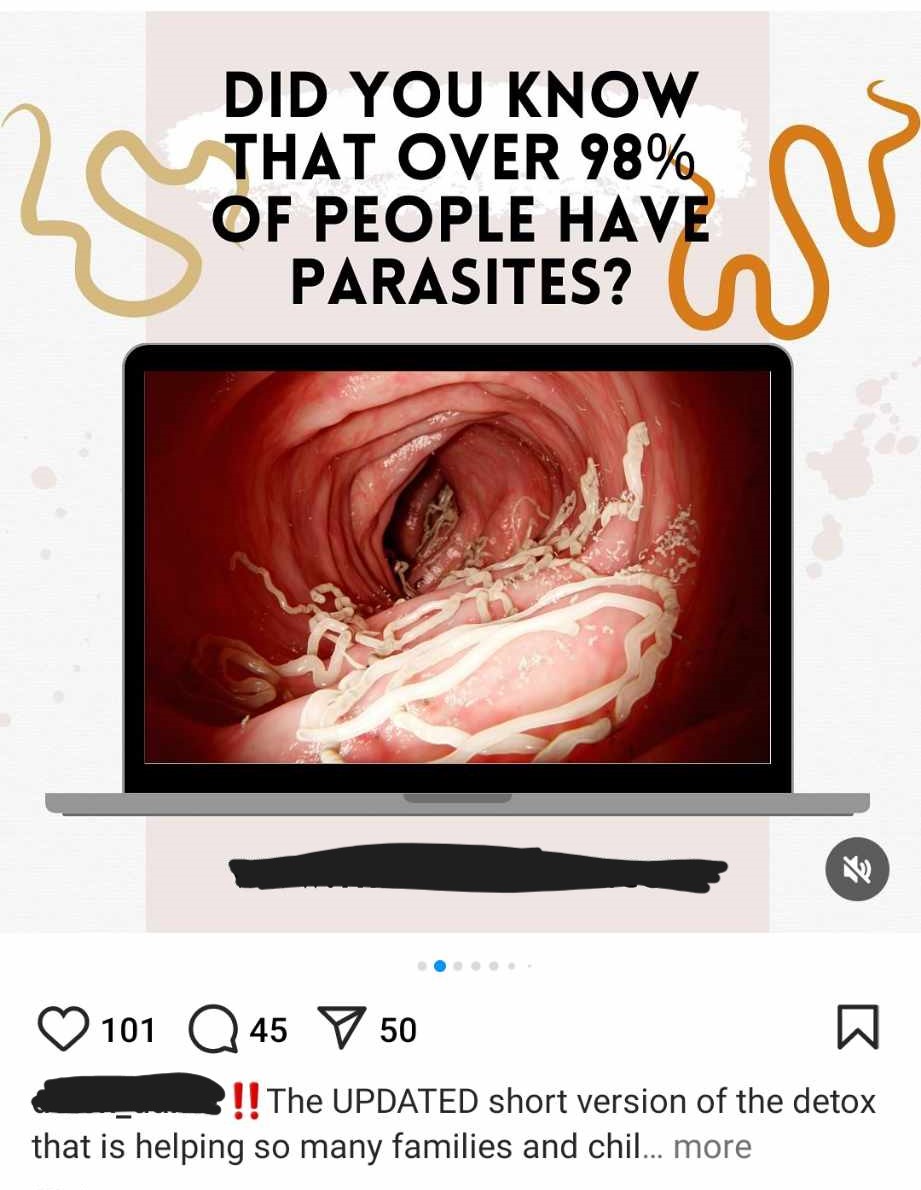
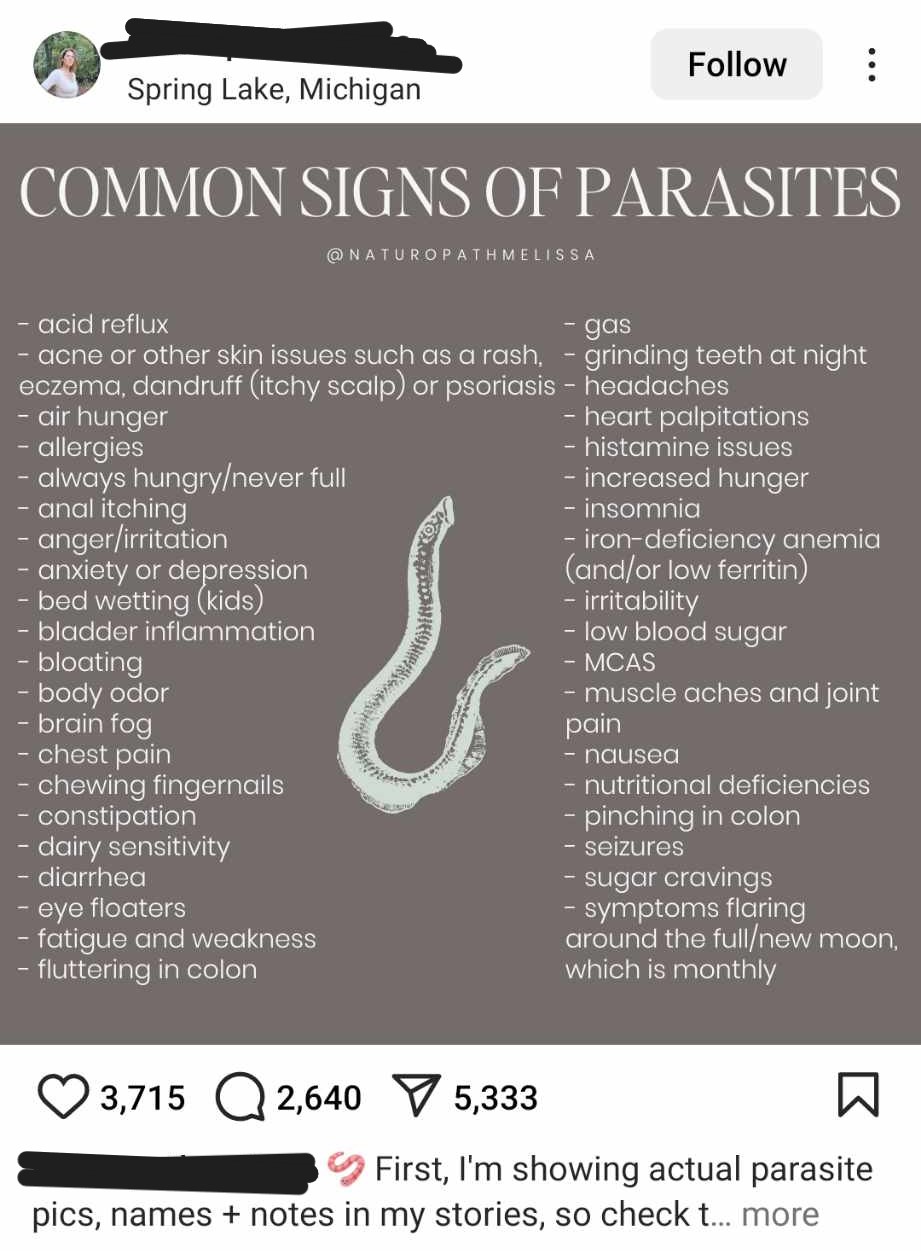
If fabricated numbers aren’t enough, they’ll gladly offer a list of symptoms that supposedly indicate you need a parasite cleanse. These lists can include just about anything. Sprinkling in some Google-able parasite symptoms, they will also list any generic symptom you might ever experience. Skin conditions, stress, anxiety and trouble sleeping are other common things listed, symptoms that can apply to almost anyone. Children are not excluded. Mothers to young children are a common demographic for those selling and buying, capitalising on parental worries. Some pages will even push their cleanses and detoxes as an option to mothers concerned about their child’s behaviour and development, especially around autism. Misdiagnosing neurodivergence as parasites and suggesting an all-natural all-curing laxative will make them “better” is a really problematic concept.
Step 2: Seeing is Believing
Now they’re going to give you some visual evidence. Be warned of a couple of screenshots below if you are squeamish! Under #parasitecleanse, you’ll see a lot of videos with people proudly gesturing towards their toilet bowls filled with various sludges of all delightful colours of the shit rainbow. Poking around in the bowl they will draw out a strand: Behold! A worm! Probably not.
A common myth is that these strands people find are called “rope worms”. This is not a real parasitic worm species, but strands of your intestinal lining and mucus that can be shed during inflammatory bowel disease, some cancers and other gastrointestinal diseases. Another way to pass these strands is if you take certain alternative medicines and enemas that damage your intestinal wall. I research intestinal mucus, so I can be the first to tell you: You need that! Your intestinal mucus is vital in maintaining your microbiota and protecting your delicate tissues. Nothing good will come from chugging trendy laxatives that strip your gut for the visual effect of clearing out imaginary toxins.
Worried consumers flock to closed Facebook groups to post pictures, asking for help with identifying whatever has fallen out of them. I scoured through some examples in a large Facebook group of 15k members. The group admin and self-proclaimed parasite expert responded to all these photo enquiries with a confirmation: Yes, that’s a parasite! It’s always a parasite, no matter how unlike a worm I thought it looked, which is lucky because they sell a handy PDF on parasites for $175. Others will confirm that all images indicate a parasite infection and refer people straight to their product.
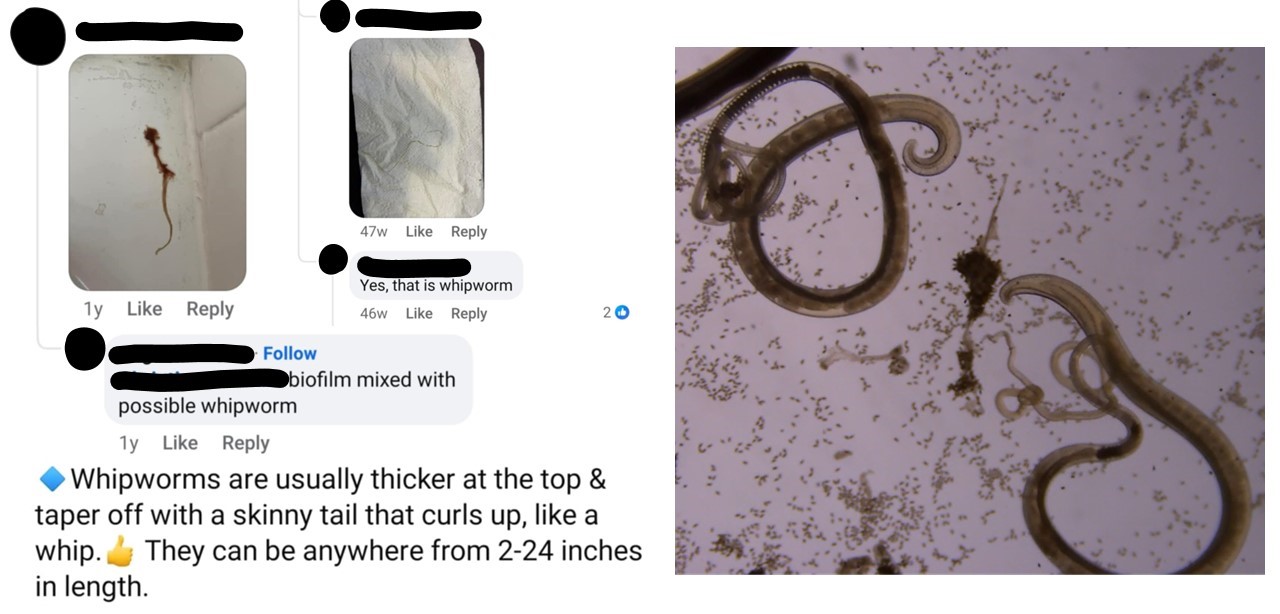
Right: An image of the REAL whipworm, the parasite I use in my research. 2 worms, Trichuris muris, can be seen among many eggs under a microscope. These worms are only 2cm long as adults. Would you pay $175 for her course on diagnosing specific parasites?
Image from Macaulay Turner.
Step 3: Trust Me, I’m Not a Doctor
After convincing you the parasites are completely real and you’re definitely infected, they need to reel you into their platform and product before you run off to see a doctor. This area is rife with manipulation and where we see a lot of contradictions.
Firstly, they want people to be sceptical of Western medicine. Many people worry about Big Pharma or have previous bad experiences with healthcare. This isn’t something I am here to mock and have even written about previously. People with unexplained chronic symptoms can feel understandably failed by the healthcare system and want to search for answers. However, I am here to stand up against those who seek to exploit people’s health and anxiety for financial gain. Videos may begin with how doctors are ignorant of parasitic infections and don’t know how to diagnose and treat them. Mixing fact and fiction at dizzying speeds to cause doubt, they want to convince you that you’re right where you should be and shouldn’t go looking for any medical advice. On the flip side, they’re always happy to flex any healthcare experience they have. Don’t trust the doctors—trust me instead. I’m not a doctor, but I have some limited experience that makes me just as qualified (if not more)!
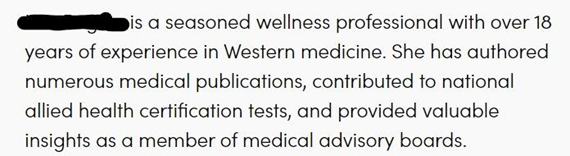
A classic tactic is claiming that Big Pharma doesn’t want to cure your infection because there’s less money in a cure. Instead, out of the goodness of their hearts, they’ll offer you a $100 cleanse that you should take four times a year for the rest of your life. Do you see the problem here? Then, on top of that, you’ll be asked to pay for their dietary courses, lifestyle coaching, pre-cleansing rituals, and “binders” to help your body fight off those critters.
Step 4: Do your Research (on my website!)
These radical free-thinkers have broken free from the mould of Western medicine and want you to do the same for the sake of your health. “Do your own research!” is the usual smug reply to any nay-saying comments questioning whether their nasty-looking black faeces are actually worms. What do they mean by research? Firstly, not the doctors! They’re Big Pharma shills. Not Google! Full of conflicting information like peer-reviewed scientific papers. Usually, they mean to loop back to their own website where they’re more than happy to re-educate you as the primary source of information. Many large creators have their own private Facebook groups where people can research therapies and learn while banning any mention of pharmaceuticals.

They want you as a repeat customer and can’t risk you finding things that doubt their magical products. Ready with a million excuses to get you to try again if it doesn’t work, they keep you in their networks. Unsurprisingly, many solutions involve getting further invested in their numerous paid plans and health concoctions.
Step 5: Worm Your Way out of Liability
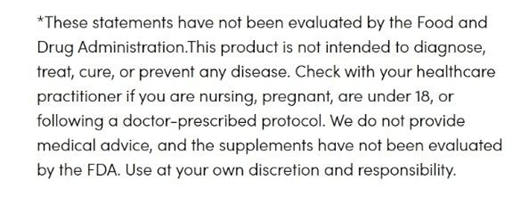
Even though they’re exploiting loopholes to sell advertised medical products without any pesky regulations, they still need to exercise some caution. Medicines are of course very heavily regulated, but when you label something as a “dietary supplement”, you have more wiggle room. For this reason, there is a large disconnect between the wording they use on social media versus the small print under the product.
I got a proud response to an enquiry I made, that a kit can treat ALL species of parasites, even non-intestinal species, yet the website says it’s not intended to treat any disease! It is easy to slip under the radar if your product fits under the FDA (USA) or FSA (UK), who don’t have the resources to investigate every pop-up dietary supplement until they get reports of harm caused. They will discourage people from seeking medical advice on social media, but again the small print will contradict this to protect themselves.
Ambiguity is their best friend! From all my trawling, I rarely saw any mention of parasite species names. Usually only mentioning tapeworms and the mythical rope worms, which in videos are both clearly strands of intestinal lining. The only specific parasite mentioned in pinworm/threadworm. This is a common infection in young children in the UK and the US, with the main symptom being anal itching at night. A visit to the GP will land you a prescription for mebendazole. This is cheaper and quicker than a 30-day parasite cleansing ritual (as an added bonus, it will actually work too!). Despite my questioning, I couldn’t get any answers on species names beyond “It works on the microscopic too!”. 600,000 people are dying yearly from malaria, a disease caused by the microscopic bloodborne parasite (Plasmodium), but accounts with real faces behind them don’t quite have the gall to claim it will treat that by name. Keeping it vague is important to gain trust, but not make a claim so outlandish the agencies come knocking.
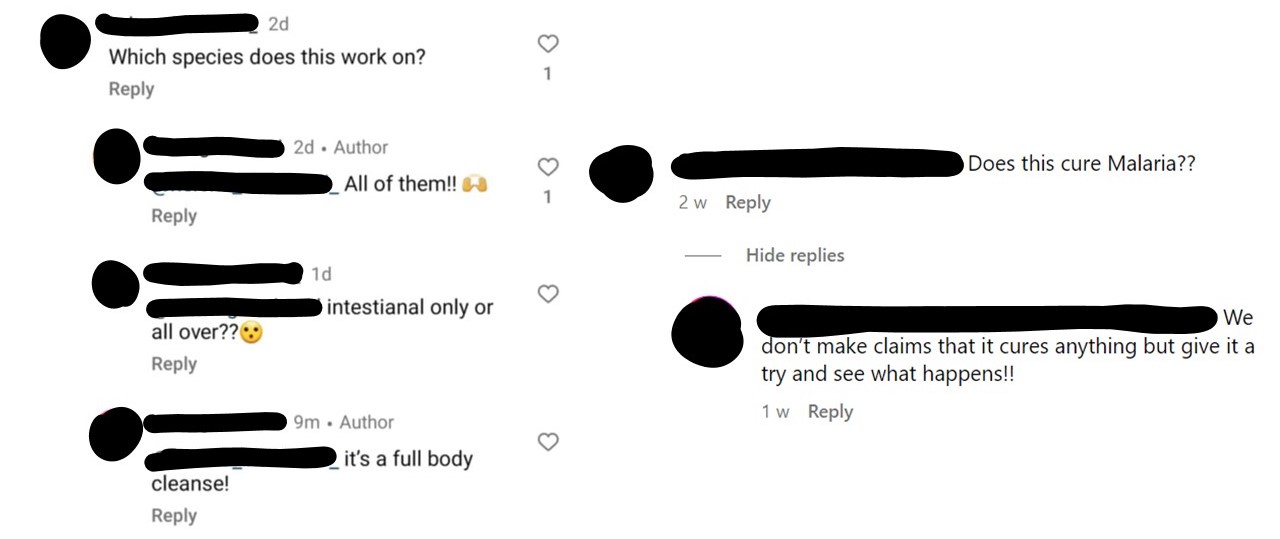
This is the same with the claims of what their products do. Immune boosting, gut-supporting, and detoxifying are favoured terms as they’re hard to prove and hard to disprove. All sound wonderful and technical to a potential consumer, but harmlessly vague to someone with a scientific background. These all sound important, which is why you have organs that already do all the jobs that they’re claiming their product can do.
Social media health supplements aren’t going away any time soon. The sheer numbers and popularity of them makes it difficult to combat misinformation. For every myth-busting article or content creator, there are dozens of posts peddling various supplements, online courses, books and more. I hope this blog can be a start for those unfamiliar with this loud corner of the internet and that it has offered some tips on spotting some dodgy sales tactics.
FURTHER NOTES:
If you would like to “detox” your feed, Mallory is a creator who actively responds to various accounts which helped me dig through to find the most outrageous content. The Conspirituality Podcast additionally releases episodes covering way more topics in the world of conspiracies around wellness, healthcare and spirituality.
Discover more from Research Hive
Subscribe to get the latest posts sent to your email.
 Research Hive