Author: Stephanie Macdonald
We’re always hearing about the amazing work research groups do here in Manchester. But what about the work our PhD students do? In the midst of failed experiments, months of optimisation and inconsistent replicates, it’s good to celebrate when a story does come together, especially when it results in a paper. This week I caught up with final year PhD Aris Sfakianos from the Whitmarsh lab (whose paper ‘The mTOR-S6 kinase pathway promotes stress granule assembly’ was just published in Nature Cell Death and Differentiation) to talk about translation, system optimisation and of course all things stress granules.
So what exactly are stress granules?
When cells are forced into stressful situations (for example when there is a lack of oxygen) a variety of mechanisms are used to help the cell survive. One of these mechanisms involves pausing translation (the process by which cells make a protein), resulting in the formation of liquid droplets known as stress granules. Originally thought to occur simply as a result
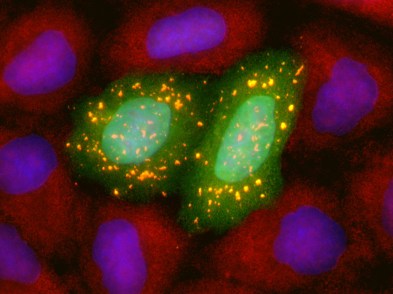
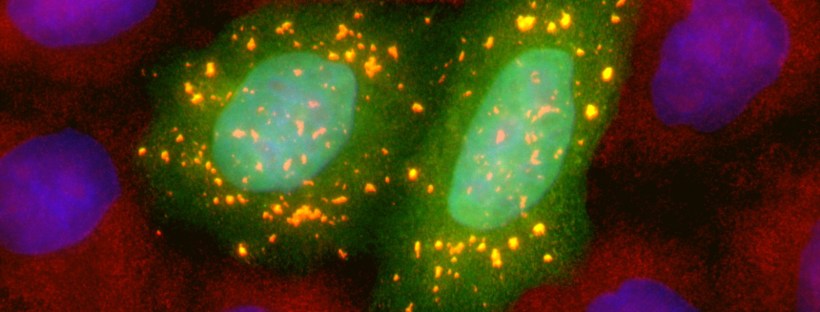
Unstressed HELA cells showing unlocalised S6K2 in green, stress granule assembly factor in red and nuclei in blue (DAPI)
of damaged proteins, many now believe stress granules are able to reprogram what proteins the cell makes, protecting the cell from stress. Pretty handy right?! Surprisingly it has been suggested that mTORC1 complex (a complex involved in translation initiation) could actually be helping to form these stress granules, but the mechanism of this is still unknown.
The mTORC1 complex
By mimicking both acute and mild levels of oxidative stress in HeLa cells (cells derived from cervical cancer), Aris showed that proteins S6K1 and S6K2 (associated with the mTORC1 complex) are localised to these stress granules. S6K1 showed more localisation during mild oxidative stress, whereas S6K2 showed robust localisation in either condition. Blocking the enzymatic activity of the S6K proteins results in a decrease in the number of cells displaying these stress granules – highlighting a role for S6 kinases in their production.
Distinct roles for the S6K effector kinases
Having shown a role for S6K1/2 in stress granule formation, the next step was to determine whether there were specific roles for these proteins. This can be investigated by reducing the amount of each protein (or knocking down (KD)) in the cell and studying the subsequent effects on stress granule formation during mild oxidative stress. S6K1 KD cells showed both a reduction in the number of stress granules and their size. Initially, KD of S6K2 only showed a small reduction in the number of stress granules formed, with this effect becoming more obvious at later time points, suggesting a role for S6K2 in stress granule maintenance as opposed to formation.
Is it all about mTORC1 signalling?
As targets of the mTORC1 complex, the next step was to actually investigate the effect of inhibiting mTORC1 itself on the formation and maintenance of stress granules. Treating cells with Rapamycin (which stops proteins from being made) following induction of mild oxidative stress initially showed little effect on the number of stress granules within a cell. However, upon removal of the stress the number of granules was greatly reduced. So which is it? Is S6K2 dependent on mTORC1 signalling or not? Well, actually it looks like it could be both. Together these experiments demonstrated roles for S6K2 that are both dependent and independent of both mTORC1 (a nod to future direction there)!
A wider application
Initially, I wondered (somewhat naïvely) what the wider impact of this research was, when do our cells ever enter a state of oxidative stress? Well, during the early stages of cancer, cells enter into a hypoxic environment. This means they are starved of oxygen and unable to get rid of their metabolic waste, which in turn prevents them from being able to divide as quickly. In other words, they enter a state of oxidative stress. So how do the cancer cells overcome this? You got it, they form stress granules allowing them to adapt to these new conditions and successfully divide (and all this time I thought the stress granules were trying to be helpful)! Understanding more about the mechanism of stress granule formation could lead to more insight into cancer cell survival and progression.
But it doesn’t stop there. Stress granules have also been linked to neurodegeneration and ageing, which is coincidently where Aris hopes to direct his (soon-to-be) post-doctoral research next! I for one wish him every success and hope he can prevent me from aging anymore before it’s too late!
Meanwhile, you can check out Aris’s current paper here.
Discover more from Research Hive
Subscribe to get the latest posts sent to your email.
 Research Hive
One thought on “Researcher Spotlight: Aris Sfakianos”