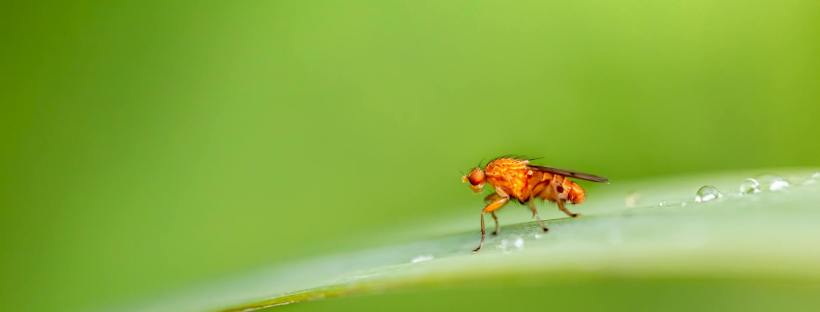
Image: Sam Scott @Flickr
Author: Jo Sharpe
Over 100 years ago, Thomas Hunt Morgan reported the identification of the white gene in the fruit fly Drosophila melanogaster. Since then, Drosophila has been established as an excellent model for studying biological systems and human disease.
The humble fruit fly is cheap, easy to keep in large numbers, and provides a powerful set of genetic tools. Despite being invertebrates, flies have important similarities with humans; research using the fly has given us insights into fundamental principles that underpin our own biology, such as circadian rhythms, embryonic development and nervous system organisation. In fact, ten Nobel Prizes for Physiology or Medicine have been awarded for discoveries made using Drosophila, including most recently to Jeffrey C. Hall, Michael Rosbash and Michael W. Young for their discoveries of molecular mechanisms controlling the circadian rhythm.
Despite previous successes, drosophilists are facing a potential loss of funding for their research. The problem is that a large proportion of Drosophila work focuses on the nitty gritty, fundamental questions underpinning key biological processes, and this just isn’t trendy. There has been a suggestion that Drosophila research may be suffering as a result of the recent political trend to favour funding translational research over basic science.
Why is this worrying? Firstly, “basic” is an unfortunate term; this research is essential to help us explain complex biological systems which in turn facilitate the research that is considered to be of greater relevance to the public, such as the discovery of drug targets. To put it simply, you cannot build a house without solid foundations, and you need a solid conceptual understanding of the system involved before you can start to hypothesise which pathways to target for therapy.
It seems that enthusiasm for using flies to teach classical genetics in the classroom has waned over recent years, meaning that fewer members of the public seem to have encountered them. It is hardly surprising that policy-makers and those in charge of allocating funding are often disregarding Drosophila research -they simply do not recognise its value. Science outreach programmes, often overlooked by busy researchers, provide a platform to emphasise the importance of Drosophila research to scientists, politicians, and the public.
A fantastic example of how to do outreach is the Manchester Fly Facility, a central research facility set up with funding from the Wellcome Trust and The University of Manchester. It comprises over 10 research groups working on a variety of topics, but the facility is more than just groups of working drosophilists.
A need for increased communication of Drosophila research was recognised by members of the Facility and it was decided that action should be taken. What started with stands at science fairs has since grown to become an established and multi-faceted outreach programme with the aim of raising awareness of Drosophila research. It is uncommon to see such a strategic approach undertaken by a research facility when it comes to outreach, most preferring to pour the majority of their time and resources into their research, unsurprising in the current “publish or perish” climate.
Amongst the many resources produced by the Fly Facility, the ‘droso4schools’ project stands out as a major breakthrough into establishing Drosophila as a tool for teaching. A collaborative effort with teachers in partner schools, lessons are developed to teach curriculum-relevant topics by making use of the profound conceptual understanding existing in Drosophila. By bringing living organisms into the classroom, students are learning biological concepts in a new and engaging way, whilst appreciating the value of using flies in research. The lessons, as with all their resources, are freely available online so they have the potential to have a far-reaching impact. It is hoped this project can be a paradigm for long-term school engagement that can be applied to all areas of science.
As a PhD student who works partly within the facility, I had the opportunity to volunteer at a recent science fair as part of British Science Week. The stand comprised two tables, one set up to display videos and live images of larvae moving round a petri dish, and the other lined with microscopes set up for an activity involving identifying marker mutations in flies. In the short video clips, direct comparisons between human and fly behaviour were made, including a fly that had been given alcohol. Using these clips we could explain how we can use flies in research because they exhibit motivation, memory, aggression, and other traits observed in humans. The school pupils were clearly entertained by the drunken fly, but seemed surprised that such a tiny, inconsequential insect could have such a complex set of behaviours. Visually, the stand was very attractive and engaging; posters presented information about homologous genes in flies and humans that were mutated in human disease, how a fly lab looks and works, and how many systems are conserved in flies and mammals. The microscope activity proved very popular and the students seemed really intrigued by the concept of using flies in the lab.
A common problem faced by exhibitors at science fairs is how to balance fun and education. Children will not hang around for long if all your stand has to offer is bland educational videos, but creating an exciting activity that captures the attention of children can sometimes render the science a moot point. You want the pupils to leave your stand having really engaged with the activity and the science. You want them to feel enthused and curious to learn more. At the end of my session, I overheard one student exclaim “flies are cool!” as he walked away.
It seems to me like the Fly Facility has their balance just right.
The Manchester Fly Facility is a stellar example of how to create and organise an effective science outreach programme. They have developed a scheme that targets audiences at all levels and is long term, strategic, and well-coordinated. I saw first-hand how much of an impact well organised and carefully curated outreach can be.
Find out more below:
http://www.flyfacility.manchester.ac.uk/
Discover more from Research Hive
Subscribe to get the latest posts sent to your email.
 Research Hive
One thought on “Science Outreach: A Fruitful Endeavour?”