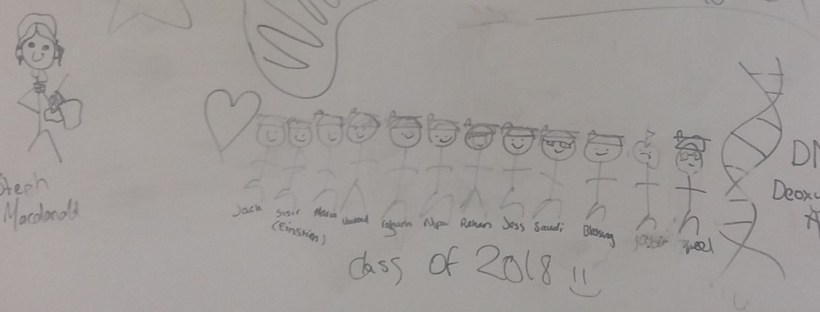
Author: Stephanie Macdonald
Each week we get a great round-up of all the opportunities available outside of our research from the DAGS team. But, what we don’t get to hear are any first-hand experiences. If, like me, you have the tendency to bite off a bit more than you can chew, it can be helpful to know in advance how much commitment these endeavours require. As a big fan of public engagement, when I saw a paid opportunity (£500 per placement plus travel expenses) with the Brilliant Club I jumped at the chance!
What is The Brilliant Club?
1 in 4 of the most advantaged students progress to a highly selective university. But for the most disadvantaged students, this number can be as low as 1 in 50! The Brilliant Club aims to change this, increasing the number of pupils from underrepresented groups progressing to highly selective universities by utilising the experience and passion of PhD students. Working as a PhD tutor in the scholar’s program involves designing and delivering a course, in the form of 7 tutorials, based on your own research. While most of us can probably see the benefits of participating in a program like this, it’s always helpful to know what it actually involves.
The application process
After filling out a fairly standard application form the next step is the interview. Whilst assessment centres are becoming a more common interviewing technique, the brilliant club also require candidates to deliver an 8-minute lesson to two of the interviewers who take on the role of 14-year-old students! This mimics, as best as it can, the environment you would be in during an actual tutorial, with interruptions and endless questions.
The training and prep
So you’ve survived the interview, what next? Well, the lovely people at The Brilliant Club don’t like to throw you in at the deep end without a life jacket and provide a training weekend loaded with information from effective questioning to engaging with pupils. I’ll admit at first I was sceptical of dedicating a whole weekend to training, but it was actually amazing! Not only did I come away with a whole bag of great teaching techniques but also feeling super positive about my own abilities.
Feeling inspired I set out to make my tutorial handbooks. Tutorials taught in both the winter (September-December) and spring (January-March) terms require tutors to design their own course, normally based on the mini-lesson delivered in the interview. These are aimed at either KS4 (14-16 years old) or KS5 (16-18 years old) and are taught in 2 x 60-minute sessions, with 6 pupils in each. For me, this was the most demanding part and my advice to future tutors would be to allow a lot of prep time for making the handbooks, developing the content and designing the assignments! If designing a course isn’t for you don’t worry, during the summer term (April-June) a range of pre-designed courses to deliver to the younger students are also offered.
The launch trip
In addition to an introduction to the program, students are taken on a campus tour of a local highly selective university and have the opportunity to meet current undergraduate students. The launch tutorial is the first impression your tutees get of both the topic and of you as a PhD tutor, so naturally, I was a bag of nerves. What if they hated it? What if my seriously under-practiced strawberry DNA extraction experiment didn’t work?! However, about 2 minutes into my tutorial I realised I needn’t have worried. The pupils engaged both with the topic and the university style of teaching, resulting in both animated discussions and endless questions (seriously never underestimate the levels of questioning from a 14-year-old)!
The tutorials
The following tutorials are taught at the host school, many of which are fairly rural, so it can be a bit of a nightmare to get to, especially if you’re relying on public transport! Appreciating not everyone finds DNA packaging as interesting as me, I tried to keep tutorials as practical as possible, with interactive models and games. Homework is set after each tutorial building up to a final assignment set in tutorial 5. This generally consists of a 2000-word essay set around a question from the tutorial handbook. After a draft submission and feedback session in tutorial 6 (meaning a quick marking turnaround for the tutor), the final assignment is submitted online. At this point things can get intense again, as you’re not only required to mark your own 12 pupils’ assignments but also to moderate others, so good planning is a must!
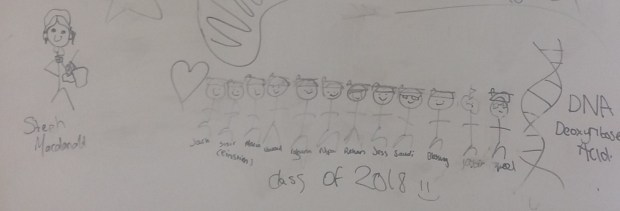
Whilst I have enjoyed every minute of working with the Brilliant club I won’t deny that, at times, it’s been tough and a big commitment. It takes a lot of organisation and the ability to be able to plan tutorials around your research. However, delivering the final grades last week and seeing the pupils realise their potential made it all worth it. For anyone considering a career outside of research, from teaching to project management and communication roles, the skills learned through becoming a PhD tutor are invaluable. Now, for my pupils at least, it’s time to graduate!
For more information visit:
http://www.thebrilliantclub.org/the-brilliant-club-for-researchers/working-as-a-phd-tutor/
Discover more from Research Hive
Subscribe to get the latest posts sent to your email.
 Research Hive
One thought on “Joining the Brilliant Club”