
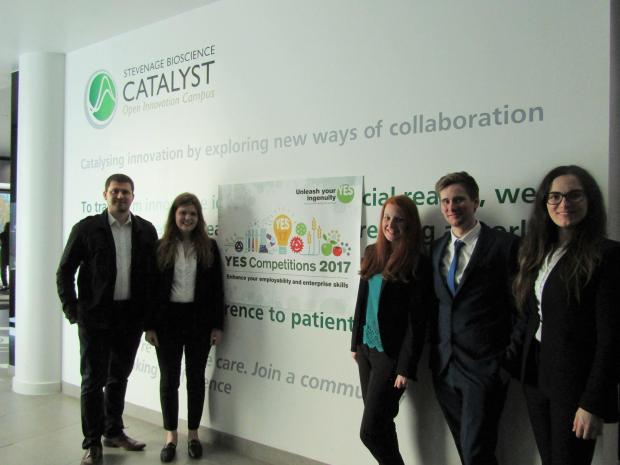
 The career path whilst undertaking a PhD can too often seem like a narrow passageway, filled with pitfalls and obstacles, with the only goal being an academic position at the end. It can be difficult to imagine how research in the lab can be applied in a career outside of a university. Commercialisation of research and entrepreneurship, for example, can appear to be an incredibly complex and difficult process, but schemes exist to introduce PhD students and early career researchers to this possibility. The BioTech YES (Young Entrepreneur Scheme) competition is an accessible scheme designed to encourage business awareness in young researchers. The competition takes place at a workshop in October/November, where teams compete for a place in the finals at the Royal Society in London.
What is the scheme and what does it involve?
The overall purpose of the BioTech YES scheme is to introduce participants to the concept of entrepreneurship in the field of biotechnology, with other YES themes including environmental, energy and chemical sciences. The competition involves forming a fictional company within a team of between 3-5 members with the aim to develop a hypothetical product or service based on real science that they believe has the potential for commercialisation. The members of the team assign themselves roles in the fictional company (Chief Executive, Chief Scientific Officer etc.) and present an outline of their business plan to a panel of business representatives that act as equity investors. The scheme teaches the basics of outlining a business plan, intellectual property and patenting strategies, raising and managing finances and regulatory affairs. The competition is specifically designed for early career researchers with no prior business experience and provides an opportunity to learn from leading figures in industry, past participants and successful biotech-related entrepreneurs.
My experience with BioTech YES: BioDetect LTD
I participated in BioTech YES 2017 as part of a team of students from the CDT in Regenerative Medicine programme here in Manchester, with my role being head of marketing. We regularly met months before the competition workshop in order to establish our target market and develop an idea for a fictional product. We eventually landed on the idea of targeting the ‘free-form’ food market through the detection of food intolerances, which are currently difficult to diagnose. Our product, which we named Intolert, was to be an off-the-shelf product that would be able to detect food intolerances in saliva. The background of our business was that our Chief Scientific Officer had discovered novel biomarkers in saliva for several food intolerances and she had developed a method for their detection. The board members (the team) then assembled around the commercialisation of this hypothetical discovery. We had several invaluable meetings with UMIP, which is the branch of University of Manchester that actually helps form spin-out companies and commercialise research at the university, to help refine our ideas. Before we attended the 3-day workshop, we had a rough idea for a business plan that included the science behind our product, a marketing strategy and a financial model. After meeting with the industry experts at the workshop however, we pretty much tore up our original model and started afresh! The workshop opened our eyes to the difficult processes and regulations that surround a start-up biotech business. We pitched our business plan as a 10 minute presentation but in the end did not make it to the final in London, with the winners at our workshop presenting a novel method of transporting organs for transplant.
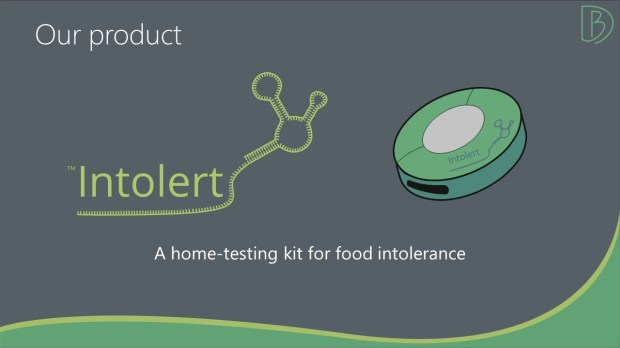
A slide from BioDetect LTD business plan presentation: This slide shows the logo and prototype of our product – Intolert
The application process and getting started
If you’re interested in BioTech YES, the first step is putting a team together. If you’re a member of PhD cohort then try asking around to drum up interest. Although 3 members is the minimum required, from our experience I would recommend the maximum 5, as there is a fair bit of work involved both before and during the workshop, so it’s a good idea to spread the load as much as possible. Applying is a simple process but it’s worth deciding which workshop you want to attend before you do. Therefore, it’s good to have a rough idea of what sort of product you want to develop; is it going to be biotechnological, medical, chemical etc? Once you have applied, be sure to attend the webinars and take advantage of any advice you can get from past participants or experienced industry members. I found the entire experience extremely valuable and although we were unsuccessful in reaching the finals, our team thoroughly enjoyed the workshop and found speaking to all of the experts fascinating. I would highly recommend taking part! You still have time to apply for this year’s competition! The deadline closes on 27th July 2018. Good luck!
Useful links
BioTech YES application form and information
Discover more from Research Hive
Subscribe to get the latest posts sent to your email.
 Research Hive
One thought on “Interested in commercialisation of your research? BioTech YES!”