Should you make time to engage the public in your research, or is it a distraction from your PhD?
Author: Jo Sharpe
For most people undertaking a PhD, the main draw is the opportunity to carry out your own research. Asking your own scientific questions, designing experiments, and taking control of your own project of which you are the expert is an amazing experience, and of course a successful PhD is the gateway to an academic career.
However, there are other important aspects of a PhD which can be overlooked, such as opportunities to develop your own skill set beyond what is required in the lab; it is important that these opportunities are seen as a priority and not as a distraction from your research. What if you want to leave academia after your PhD? You’ve worked hard and enjoyed the research but want to move on, or you realised that the academic life simply wasn’t for you. A PhD stands you in great stead for whatever career you choose to pursue, but there are so many ways to enrich your CV with other skills.
Getting involved in science outreach is the perfect way to develop communication skills. It gives you the opportunity to connect with people about your research which can be immensely rewarding. As an MRC DTP student, I have attended a series of workshops during my first year focusing on the important of public engagement, and I have definitely caught the bug! Whether you are keen to engage with children or an older audience, there is something out there for everyone.
How can you get involved?
There are many chances to work with children and young people and for some it is the most rewarding kind of engagement. The knowledge that you helped a keen young scientist pursue science beyond school, or that you imparted some knowledge that will stay with them forever, is immensely satisfying. Nurturing young inquisitive minds and encouraging critical thinking is so valuable for any child regardless of whether they wish to continue into a scientific career or not.
If you are interested in working with older school pupils and are willing to invest your time into planning lessons and running workshops on a fairly regular basis, applying to be a Widening Participation Fellow is an excellent place to start. Not only do you receive formal training and the opportunity to design and lead your own workshops, you are also paid for your time. The aim of the scheme is to improve participation in higher education from low participation groups and therefore you gain a lot more from it than simply an excellent addition to your CV.
On a similar theme, joining Brilliant Club as a PhD tutor on the scholars program allows you to design and deliver a course in the form of 7 tutorials based around your own research. Check out Stephanie Macdonald’s post from the Hive for more information.
There are other opportunities to work with children that aren’t as formal and do not require long-term commitment. A good way to try out public engagement is volunteering on a stand at science fairs. I helped out at two such stands in my first year, once as part of Manchester Science Spectacular – a fantastic event held each October. If you get the chance to develop your own activities for stands at science fairs, you can really unleash your inner child and get creative.
There are fewer opportunities to engage with adults but this does not mean it is not equally as important. There is a responsibility of scientists to share our research; there needs to be transparency to assure the public that scientists are not squandering charity money. Some view scientists negatively, as uptight, self absorbed individuals who don’t care about the general public, only about their work and getting a Nobel Prize. It is so easy to get caught up in your research – we are researching tiny problems that make up a giant jigsaw and it is easy to forget the fundamental reason for our research. That is why outreach is important, it helps shift your focus to the bigger picture: why do we do what we do, and why it is important.
Public engagement is a conversation not a lecture. Most people have the ability to understand if you avoid jargon and explain concepts using terms they are familiar with. Questions from the public may catch you off guard but often naive questions can be the most thought provoking. Being able to respond to these questions not only develops your ability to communicate complex theories as understandable concepts, but also can be a really valuable reminder of the thoughts and concerns of non-scientists. Our research may feel like our baby, that nobody else cares as much as we do and nothing else matters, but encounters like these remind you that there are other people invested in our work.
A Student’s Perspective
As she nears the end of her PhD, Catriona Cunningham explains why she continues to invest her time in public engagement:
“It’s a really nice break from lab work and reminds me of the importance of my research. I love how it challenges my communication skills. At events such as the University of Manchester Community Festival and Body Experience, people of all ages and backgrounds can walk through the door and you have to adapt your explanations accordingly. It’s our responsibility as scientists to go out and tell the public how we’re spending their money but it doesn’t have to be a chore.”
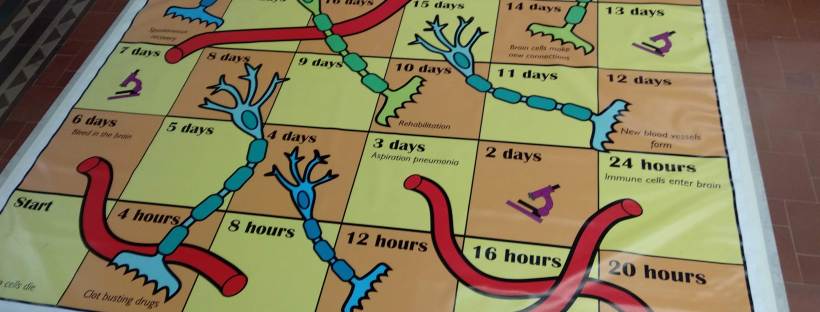
There is also the opportunity to win funding to develop resources for public engagement. Catriona and her group, who focus on stroke research, were awarded an ISSF Wellcome Trust public engagement grant to develop new activities to explain their research. “I had so much fun being involved in developing a giant snakes and ladders game to explain the pathology of stroke and therapies our lab are researching to promote recovery. We also made a giant Kerplunk style game to explain how blood clots can cause ischaemic stroke and how thrombolysis breaks these down and restores blood flow to the brain.”
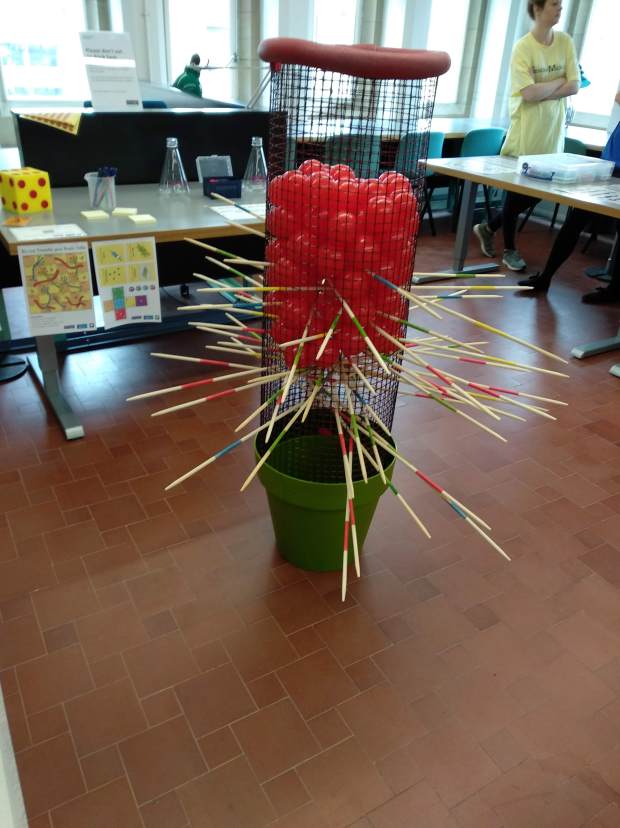
Scientific Kerplunk explains how blood clots can cause ischaemic stroke and how thrombolysis breaks these down and restores blood flow to the brain
In short, there are a plethora of ways to get involved in outreach, requiring different levels of commitment, so there is sure to be something to suit you. Check out the university’s public engagement pages to find out more about other opportunities here at Manchester.
Discover more from Research Hive
Subscribe to get the latest posts sent to your email.
 Research Hive
One thought on “Public Engagement During Your PhD”