
Author: Nadine Mirza
In today’s reality, with dementia being the UK’s leading cause of death and no cure in sight, we make do with second best: be it informing ourselves, preventative measures (eat your greens, run that mile), disease management or therapy. But what if second best is not equally available to everyone? With high rates of dementia yet far lower presentation to services, British South Asians (BSAs) are showing they can’t access second best and up until recently it has been the onus to blame them. However, working in population and health services research, I have become privy to some of the ugly truths at fault and in a bid to tip the scales in my fellow South Asians’ favour my research endeavours to improve their access to, and experience of, dementia services.
Dementia shows a particular greed for BSAs. Estimates for the UK from 2011 show that they have the highest prevalence in 65-79 year olds and second highest in those who are 80+. That’s a lot of dementia going around in what is a minority group. Yet, this is unsurprising when we remember that the many BSAs who migrated to the UK between the 1950s and 1970s, as young adults to satisfy the demand for cheap labour, are now hitting the golden years.
Add to this the fact that everything we know to be linked to developing dementia, South Asians have in spades: diabetes, hypertension, and a whole collage of cardiovascular problems. Have you seen what we eat? We have a dessert that is a coiled creation made entirely of deep fried sugar and syrup covered batter. Plus, there is a tendency to prioritise this variety box of diseases and conditions, which appear more overtly, over possible dementia, which may be less evident. Couple this with lifestyles that hold higher powers or karma responsible for health (“she was always such a snake, that’s why this is happening”), rampant stigma and a lack of awareness, with many South Asians mistaking dementia for regular ageing – dementia is seen as inevitable. On top of this, it can be tough to talk about dementia when the word doesn’t even exist in your language.
But this is the half of the story promoted to avoid acknowledging the reports of not being believed, facing disrespect, cultural insensitivity and racial discrimination from those BSAs who do approach dementia services. At times it is the subtle perception of older BSAs as being “dumber” than their Caucasian counterparts, biasing professionals from acknowledging dementia, with lapses in cognition attributed to not being fluent in English or not being exposed to a “western” education system. In other instances, it is outright stereotyping. One woman I interviewed described how it took 15 years for someone to do a cognitive assessment of her husband, who had grown increasingly violent as his dementia worsened. Her concerns were dismissed because apparently it was easier to believe a South Asian man was beating his wife (“that’s just what they do where he’s from!”) as opposed to something being wrong.

Such reports, naturally, put off many from further interacting with professionals and the spread of these reports within tightly knit communities further exacerbates the problem, deterring others from approaching services. When the dementia progresses so far that outsider intervention becomes unavoidable, the irony is that the window of opportunity for any kind of treatment is slammed shut by that very disease progression.
The discouragement continues for BSAs who are assessed. They find themselves facing interview questions and cognitive tests that, literally, may as well be in French. Transcultural approaches have only just taken off and so we’re still playing catch up when it comes to the screening and diagnostic tools being used. The failure of these tests in not matching language and cultural context leaves BSAs with a high rate of false positive scores – being misdiagnosed with dementia – or false negative scores- not having their dementia detected and therefore not being signposted to further information and help. Our research team’s enquiry into memory clinics across the Lancashire area also revealed a third problem: incomplete assessments due to communication barriers and therefore no official diagnosis determined.
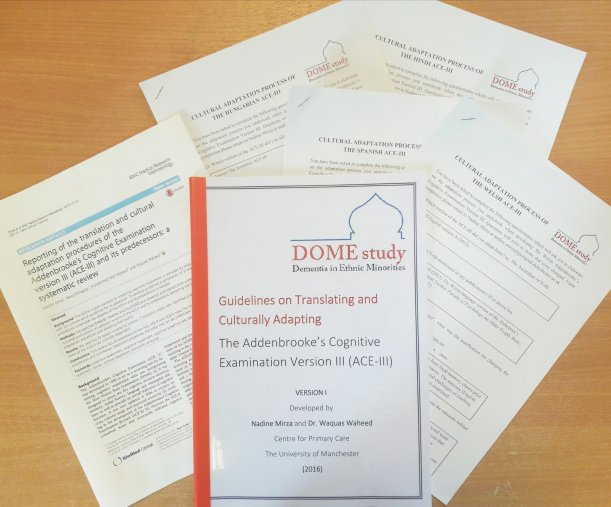
This is what my PhD research is accounting for through developing a toolkit which will have educational and service materials for those with dementia and their carers, culturally adapted cognitive tests and interview schedules in a popular South Asian language and cultural sensitivity training programs for staff. All designed with BSAs in mind. It will be produced through the experiences of BSAs who have gone through the dementia diagnosis and care pathway, either as a service user or carer, and captured through interviews, focus groups, community engagement and PPI groups about what went right and what went horribly horribly wrong. Their advice and beliefs, their wants and needs, will shape this toolkit’s contents. When it comes to fruition it will be implemented within select memory clinics to observe whether it improves BSA access and retention within these services.
Being South Asian myself, it seemed predestined by heritage sewn into the third culture patchwork of my life that I would work with South Asians in some way. Having studied psychology I imagined it would have been in a clinical capacity but after a research based masters, with a dementia driven supervisor, at a time where dementia research happens to be in demand, I fell into this particular trajectory. 20 years ago, it might have been AIDS; 50 years ago, possibly cancer. But it happened to be now, and it happened to be dementia. My MPhil, which looked at cognitive testing in BSAs, triggered this intrigue in not only dementia, but its impact on the lives of South Asians and ethnic minorities in general. I couldn’t move on from it for the risk of the research fizzling out. Or worse, missing out on being the one who got to do it.
Even though this work does not look like dementia research in a traditional sense – there are no biochemical or pharmacological breakthroughs from my office – it is still countering the fundamental issue that while we say dementia does not discriminate, the means to addressing it clearly do.
At least, for now.
Blog: thealmostpsychologist.wordpress.com
Twitter: @thealmostpsych
You can read more about the project and its aims here
Discover more from Research Hive
Subscribe to get the latest posts sent to your email.
 Research Hive