At the University of Manchester we are fortunate to have plenty of opportunities to communicate our research to the public through events that run as a regular part of our calendar. Yet, it can be daunting to think about how a research project or results can be translated into an engaging activity to suit a general audience.
In this blog piece Isabel, Nic and Dawn talk about their experiences at the University of Manchester Community Festival.
Dr Claire Planner (NIHR School for Primary Care Research Fellow)
An experiment to show how your surroundings and mood impact on your behaviour
By Isabel Adeyemi (PhD student)
Every June the University of Manchester opens its doors with an array of fun and interactive activities for families. The festival is an opportunity for families and other visitors to get hands-on with some of our research including taking part in live experiments, interactive demonstrations musical and dramatic performances, and meeting staff and scientists. Last year, I volunteered for the first time to run an activity related to my PhD work.
I was supported by colleagues at the Centre for Primary Care who helped me to brainstorm ideas. My aim was to have one or more fun activities for children which communicated to them elements of my PhD research. I focused on explaining to them how their decision to sit down versus to run around could be influenced by their surroundings, the people around them, and their mood.
I organised two activities: the first was a simple obstacle course, the second was to sit down and do some colouring. The latter activity included a “television” made from cardboard which children could also colour in or stick their drawings to. The contrast of the two environments helped to illustrate how their environment could encourage them to sit down more or to run around. Children were asked which environment they would choose if they were with their friends (generally the answer was the obstacle course) and which they would choose if they were on their own (the popular choice was watching television and colouring in). They were also asked what activity they might do if they were feeling a bit down (the answer was usually watching TV). After taking part, children were given a sticker and a certificate of achievement.


I am really grateful to have been involved in the community festival and I had a great time although there were some challenges, for example, using a space I was unfamiliar with and making sure there were enough hands on deck to run the activity and keep everyone engaged.
The community festival event reminded me of how much children love stickers and certificates, and that all activities need helium balloons! The best part of the day for me was to see a queue of children waiting to try out my basic obstacle course. I also think parents may have appreciated the opportunity to sit down whilst their child did some drawing!
Taking part in public engagement is important. It’s a chance to demystify research and inspire younger generations. For me personally, it was a chance to reflect on how I communicate my complex research to children and to show them that they too are capable of thinking scientifically.


What Matters to You, Matters to Research
By Dr. Nicola Small (Health services Researcher in patient experience) and Mrs Dawn Allen (Patient and public involvement partner)
Last year, for the first time, we volunteered to take part in the University of Manchester’s Community Festival on Saturday 16th June 2018, and we’re happy to say, it lived up to our expectations!
We were immediately keen to plan an activity together which would promote the importance of including the patient and public involvement perspective in our research.
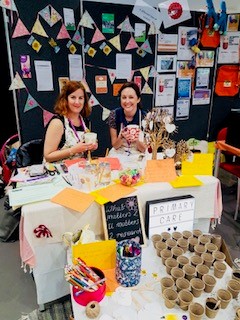
Sowing Seeds for Research
We thought of a simple yet engaging crafting and planting activity for people of all ages to take part in. Children and adults were encouraged to write or draw on a heart shaped tag, using coloured pens and pencils, a topic that they would like to see researched, and to hang the tag(s) on our wooden research tree. Dawn believes ‘crafting has many benefits including expressing yourself creatively’.
We then invited them to plant their research ideas – sunflower seeds – in a biodegradable pot to take home.
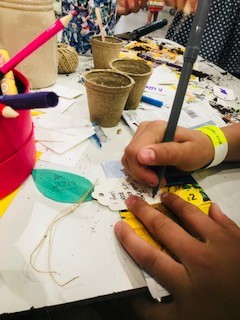
Everyone liked the research tree and the concept behind it. Our activity was an example of PPIE in action, where we partner with people with lived experience to improve the quality and meaningfulness of our work.
Members of the public at the Festival told us they valued the opportunity to talk to us about what we do, and why we do it. Many people asked us how to get involved in research which was the idea behind our activity. Some people had travelled as far as Liverpool to come to the University for the event.
The best part of the experience was seeing that adults and children knew immediately what mattered to their health!
‘More research into ‘old age’ memory loss!’
‘My mummy and Pepper (the cat)’
‘Stress management for teachers’
‘Voice problems with children’
‘Research on disability’
‘We need more GP’s to work with my Dad’
As well as the importance behind doing research!
‘When I hear about research, I think about saving lives’
‘Research helps people go forward’
‘The doctors made my eyes better’
‘Research is very good because it identifies bad things’
‘Research has helped with my family’
Children loved planting the sunflower seeds (‘sunflowers make me smile’) and being able to write their name on a lollipop stick to plant in a biodegradable mini pot to take home. We noticed parents carrying our mini biodegradable pots all over the festival – sorry that we did not provide paper bags!
Dawn reflected: ‘I enjoyed becoming part of a creative event that encouraged me to talk about being involved in improving health research and finding out what children already knew about what research is’
Likewise, Nic thought: ‘we were able to engage with the community about the importance of the research that we do in primary care, and how we go about developing research proposals from scratch, and how our patient partners help us to shape research proposals’.
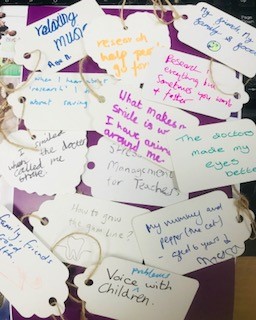
Finally, we have a research tree full of research topics that the community have identified as seeds ripe for research ready to submit to NHS 70 ‘Suggest an Idea for Research’
We also have a huge pot of sunflower shoots in Nic’s garden to remind us of the event’s success and a beautiful wooden research tree to reuse at other @PrimaryCareMcr events and occasions – Dawn recently used the decorative tree at her wedding! All in all, a true partnership!


Related posts
Division holds first PPIE stand at community festival
Find out more about this event and others on Twitter:
@PrimaryCareMcr
@FBMH_SR
@MRCSTART
#sr4health
#SowingSeeds4Research
#CommunityFestUoM
Discover more from Research Hive
Subscribe to get the latest posts sent to your email.
 Research Hive
Fantastic to see this work presented in such a fun and engaging way. I hope you’re keen to do more public engagement too – you certainly have a way of bringing complex topics to one that is meaningful for a wider audience.
LikeLiked by 1 person