University showcases and events are wonderful opportunities for all PhD students to gain experience of making posters, giving talks, and discussing research with those from different fields. It is excellent preparation for attending and presenting at bigger external conferences. Students who really excel at these events often have their hard work recognised in the form of prizes. I recently attended such an event and read some fantastic research presented on intelligently designed posters. I decided it would be an excellent opportunity to find some interesting content for Research Hive, and wasn’t disappointed.
The School of Biological Sciences Annual Event took place in University Place in January. In addition to several short talks from each division, the event gave over 60 2nd year PhD students the opportunity to present their work in a lunchtime poster session. It was a wonderful showcase of the breadth and quality of research output of PhD students. Rufus Daw of the Division of Infection, Immunity & Respiratory Medicine won first prize for his poster detailing his work on “Determining the impact of gastrointestinal nematode infection on liver immune function.”
Having seen Rufus pick up his prize, I was keen to learn more about his research and share it with Research Hive readers.
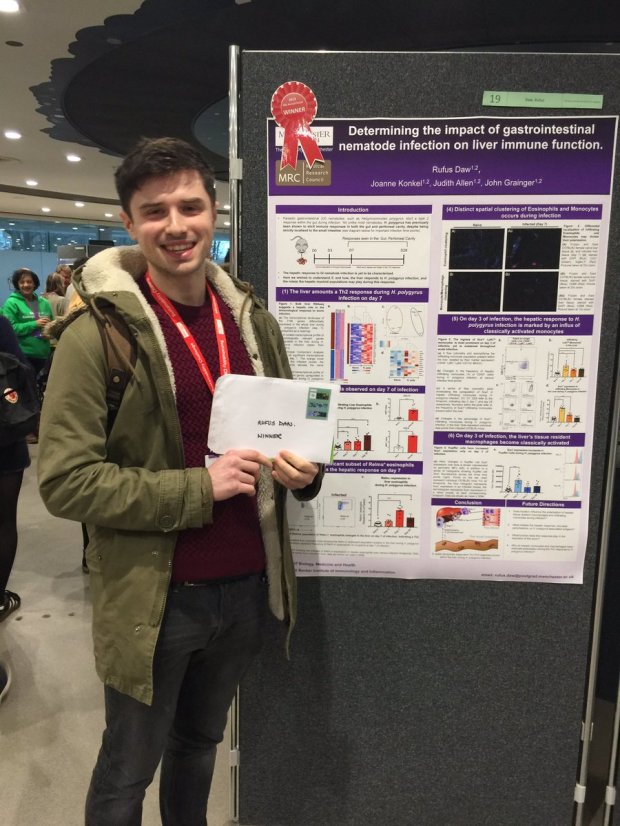
Rufus and his prize-winning poster.
The immune system is possibly the most intricate and elaborate system in the body. In order to efficiently protect us from harmful invaders whilst sparing commensal microorganisms and our own tissues, it has an extensive range of communication and regulatory mechanisms to fine tune the appropriate immune response. Even now we are still uncovering new layers of complexity. Rufus’s work concerns how tissues distal to the site of infection may play a major role in dealing with gut-worm infections.
Rufus is looking to determine the nature of the immune response elicited by Heligmosomoides polygyrus infection. H. polygyrus is an intestinal nematode worm of rodents and is widely used as a model for studying the effects of gastrointestinal parasitic infection. The infection is strictly localised to the small intestine and the immune system’s response at this site has been well documented. However, recent research has shed light on an interesting phenomenon whereby the nematode infection in the gut stimulates an immune response in distal tissues. Of particular interest to Rufus is the potential involvement of the liver in the immune response to H. polygyrus infection.
Previous work here in Manchester has shown that a type of adaptive immune response known as a “Th2 response” is elicited in the peritoneal cavity upon nematode worm infection. For those not familiar with immune cells and their function, the Th2 response refers to activation of a subset of helper T lymphocytes, Th2 cells. Helper T cells are the “coordinators” of the immune response, and the cytokines (messenger molecules) they secrete dictates which cells respond and therefore the type of immune response evoked. Th2-type cytokines include interleukins (IL-) 4, 5 and 13 which promote IgE (antibodies associated with allergic reactions) and eosinophilic (cells associated with fighting parasitic infections) responses, and also the anti-inflammatory IL-10.
So why the liver? The small intestine and the liver are connected via the hepatic portal vein and the liver is thought to respond to gut-derived signals, suggesting that the liver could play a significant role in the way the immune system responds to intestinal perturbations such as gut-worm infections.
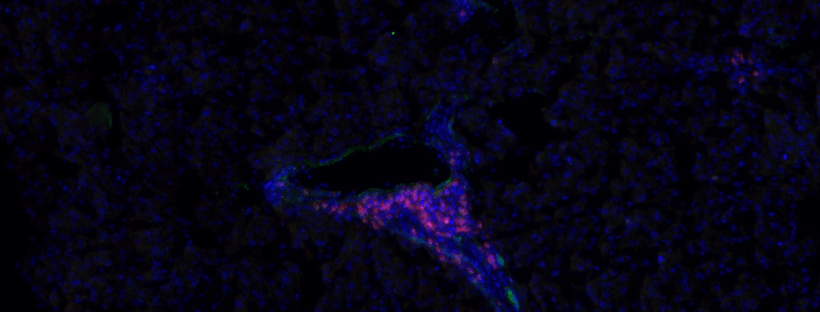
Eosinophil infiltration into the liver during a H. polygyrus infection. This image shows a branch of the hepatic portal vein in an infected mouse. Red marks infiltrating Eosinophils; green is endothelial cells.
Rufus uses mice to study the hepatic response to H. polygyrus infection and has begun to unravel how the immune system coordinates its response to gastrointestinal disruptions. His research so far has shown that there are two temporally distinct immune responses to infection likely related to the nematode’s life cycle. The nature of these sequential immune responses is also distinct: the initial response at day 3 is marked by a profound increase in a particular type of monocyte (white blood cell) and activation of other myeloid cells including macrophages. In contrast, the response at day 7 involved a Th2 response in the form of eosinophilia, comparable to the response previously observed in the peritoneal cavity.
Why is this important? Rufus explains, “This worm only infects the gut so the fact that the liver responds to it has some really interesting and cool implications for a) the liver’s involvement in gut worm infections and b) the mechanisms by which the immune system responds to intestinal perturbations!”
And what’s next? “Really, we want to understand more about the hepatic immune response, what it is that the liver is actually responding to (is it damage, the microbiota, or the worm itself?), and whether the hepatic response enables or plays a role in the expulsion of the adult worms themselves.”
Rufus’s work is not only a perfect illustration of the intricacies of the immune system, but also an example of the cutting-edge research PhD students within the faculty are producing.
By Jo Sharpe
Discover more from Research Hive
Subscribe to get the latest posts sent to your email.
 Research Hive
2 thoughts on “Student Spotlight: Rufus Daw”