You’ve worked hard for three years, poured your heart and soul into a project which has become the centre of your universe, only to find your data doesn’t tell the story you were hoping for… but is this really the bombshell it first seems? I spoke to Conor O’Boyle, a final year PhD student who has just published his work on the link between periodontitis and stroke outcomes, about the importance of publishing negative data.
Background
Conor’s project focused on gum disease, a very common condition among adults that most people experience to some degree at least once. It is caused by the build-up of sticky plaques on the teeth which harbour bacteria that can be detrimental to gum health. If the plaques are not effectively removed, gums become sore and can bleed when brushed. The early stage of gum disease is known as gingivitis and can usually be treated by maintaining a good level of oral hygiene. However, if left untreated, gingivitis can develop into the more serious condition periodontitis, where the supporting soft tissue and bone can be damaged, and ultimately lead to tooth loss.
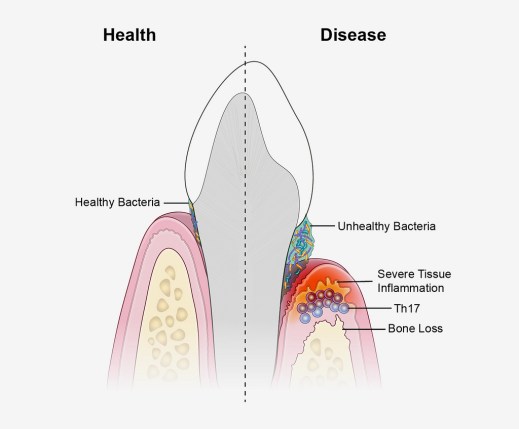
Periodontitis is the inflammation of the periodontium which includes gingiva (gum tissue), bone and connective tissues. In periodontitis, gaps open up between the tooth and surrounding tissue due to destruction of gingival fibres, allowing microorganisms that normally exist under the gum line to colonize these gaps. This results in further inflammation and progressive damage to the tissues. It is this disruption of the normal oral microbiome that drives the immune response responsible for the extensive damage to host tissues, as commensal bacteria that have colonised unfamiliar areas evoke inflammation and recruitment of cells that drive destruction of bone and connective tissues.
Obviously, tooth loss is not an ideal scenario, but is this the only danger that periodontitis poses? Conor, of the Division of Neuroscience and Experimental Psychology, has dedicated his 3 years at the university to investigating whether periodontitis could induce systemic inflammation, and if this inflammation could hinder recovery after stroke. Briefly, stroke occurs when the blood supply to the brain is suddenly interrupted by either a blood clot blocking a vessel in the brain (ischemic – the most common form of stroke) or by a blood vessel bursting within the brain (hemorrhagic stroke). Brain cells near the blockage die due to oxygen deprivation. Stroke is a major cause of mortality and survivors can often be left severely disabled. An inflammatory response, caused by stagnant blood flow and disruption to tissue homeostasis, has the potential to increase the damage caused by stroke. Indeed, poorer post-stroke outcomes are heavily associated with concomitant inflammatory and infectious disease.
Periodontitis is a prominent risk factor for stroke and epidemiological studies have shown a link to increased likelihood of stroke. Despite this, the impact on the severity of strokes is poorly understood.
The Study
Conor, along with his colleagues in the Lawrence and Konkel labs, used a murine model of periodontitis, where a ligature is placed around a tooth to induce gingival inflammation and periodontal tissue destruction, to investigate the link between gum disease and acute stroke outcomes. The mice are subject to surgical occlusion of a cerebral artery to trigger a stroke. Despite causing bone-loss, bacterial growth, and inflammation they found that periodontitis did not worsen stroke outcome, measured by, for example, infarct volume and blood-brain barrier breakdown.
Why is it so important to publish negative findings?
It is this negative data that earned Conor his first-author paper published in the International Journal of Stroke, earlier this month. There is often an unwillingness to persevere with projects that do not yield the positive outcome initially hoped for; why waste time publishing that something doesn’t happen? Additionally, in the current “publish or perish” environment, there is a pressure to not only publish, but publish high-impact papers in big journals. This has lead to a publication bias whereby only results that disprove null hypotheses are published. Conor, and many others, vehemently believe that it is just as important to publish negative findings as positive to preserve the integrity and quality of publications, and as Conor points out, it saves others time and money repeating experiments that have already been done!
Dr Catherine Lawrence, who has supervised Conor throughout his PhD and is the Principle Investigator on this project, echoes Conor’s sentiment and emphasises the responsibility of researchers to publish negative data – “Publishing only results that show significant findings can be misleading and distort the literature and, for example, in the case of testing an intervention can result in an overstatement of efficacy. This problem has been cited as a possible reason why many drugs that have shown efficacy in animal models have then failed in clinical trials.” She also added an ethical reason for always publishing your findings: “our research is usually supported by public funds, studies can also involve the use of animals and the data is often a result of many years hard labour by young researchers who need/deserve an output for their work.”
I asked Conor how he felt upon realising his project had yielded negative results: “Admittedly, it was definitely disheartening, as everyone wants that big scientific breakthrough! But I did come to realise that that’s just how science works, and I was content that once the experiments were performed and controlled well, that it’s still a valid finding and still adds to current scientific knowledge, whatever the outcome.” This attitude is definitely one that more scientists should be taking when it comes to negative results, but in the current climate a shift in perspective will not be easy to achieve when people’s careers depend on the quality of their publications. However, publications like this one will hopefully encourage others to persevere and get their equally valid and important findings out there.
By Jo Sharpe
Discover more from Research Hive
Subscribe to get the latest posts sent to your email.
 Research Hive