“Everyone deserves a fantastic workplace”
We spend almost a third of our lives at work. Look around your workplace. What do you think of the space? Is it something that could be improved? Do we tolerate the mediocre standard, just because it’s always been this way?
No, absolutely not. It shouldn’t have to be this way. And this is exactly what our invited guest speaker, Neil Usher, told us during his talk as part of the Wellbeing Lecture series here at the University of Manchester. Over the past 25 years, he’s worked to redesign and restructure the workplace and properties of many companies such as Warner Brothers, Honeywell, and Sky. His experiences have culminated to the publication of his book – Elemental Workplace.
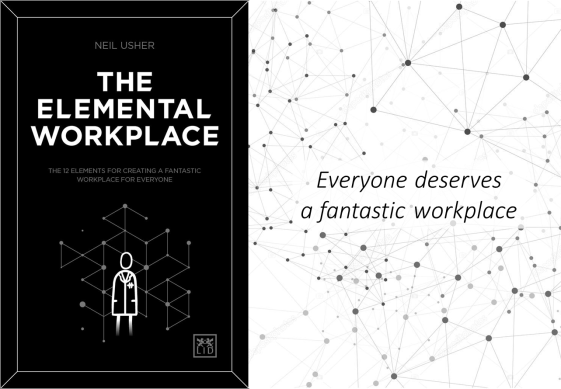
This book and his talk highlights that everyone deserves a fantastic workplace. This positive environment where we work, learn, and share with one another shouldn’t just be a lofty peak for people to aspire to. It should be the universal standard for everyone.
Wellbeing can be influenced by three key factors:
- You (your behaviour, attitude, and decisions)
- Other people (their actions can have direct or indirect implications)
- Environment (this is your home, work, transport, etc)
All of these can contribute in some shape or form to your wellbeing. But in what way? It’s tricky to categorise and form tangible indicators for this. Neil likes to use a variation of resources to describe the 7 indicators of wellbeing in a ranking out of five to map your wellbeing. You can try map out how you are now, and where you’d like to aim for next in the future.
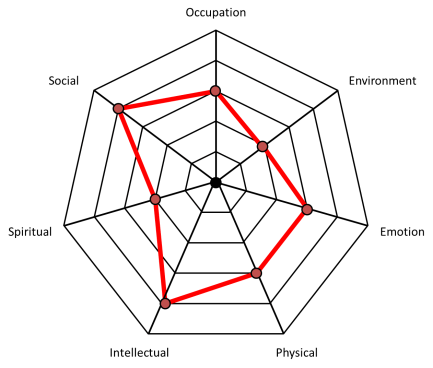
Elemental Framework for Wellbeing
As part of his book Neil has generated an elemental framework designed for the workplace environment and described how they can influence an individual’s wellbeing. This elemental table format is key as it removes the power of hierarchy.
The various aspects of the framework have no priority over one another. The workplace should be developed in such a way so that all the elements are considered, responded to and explained. The interplay between each is vital. If you let one of these elements break down, you run the risk that it will collapse the efforts you put into the others.
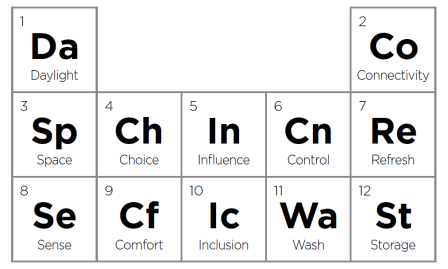
- Daylight – You want as much of it, from as many angles. It elevates mood, maintains circadian rhythm, and triggers Vitamin D production for bone growth and immune system.
- Connectivity – Ensuring all IT and communication systems are in working order. You can’t be productive without it. In this modern day, how much work can we get done if the WiFi is down and the computers are crashing?
- Space – We need sufficient space to be efficient and effective. Around 6m² is often considered enough (That’s about the space if you stood up and swung a cat around you by the tail).
- Choice – You should be enabled to choose how to enjoy and utilise your space. Do you have a choice to work at a desk with your team nearby, a quiet space to focus, an informal meeting room to bounce ideas of one another, or a formal space with a closed door.
- Influence – You should be able to interact and tailor your work space to you.
- Control – Again under the similar theme as before, you should be able to control certain parameters to suit you – such as temperature, humidity, air velocity and noise.
- Refresh – Available break rooms and a variety of choices for food, drinks and amenities. For example, coffee. The social benefits of having a manned cafe by a barista far outweighs the financial savings of having a self-service coffee machine.
- Sense – Sight, smell, sound, and touch are all factors that can influence how we feel. A hallway with strings to run your fingers along, a mandolin soundscape reception, the aroma of freshly baked cookies and coffee. These can all subtly elevate a flat and dull workplace without you really thinking about it.
- Comfort – Discomfort is a distraction. Bad chairs, cold office temperatures, unsuitable clothes. Whatever the source of discomfort, it will make you unproductive. In worst case scenarios they can lead to more serious problems such as injuries to workers.
- Inclusion – Wellbeing in the workplace should not be special treatment. It should be a standard designed for everyone.
- Wash – There is sanity in paying attention to the sanitary. A space that is clean, warm, with hot water and soap and a place to dry your hands. Sounds simple, but it is crucial.
- Storage – Somewhere to safely store your papers, purse/wallet, running shoes. And with the growing focus on wellbeing, we are now bringing it to work and we need a space to store it.
So regardless of where or who these workplaces are for. Money-rolling financial analysts in the banking district of London. Trendy graphic designers tucked away in a warehouse in Glasgow. Or coffee-riddled scientists in a lab in Manchester.
We can all create a fantastic workplace.
By Jason Chu
Discover more from Research Hive
Subscribe to get the latest posts sent to your email.
 Research Hive