
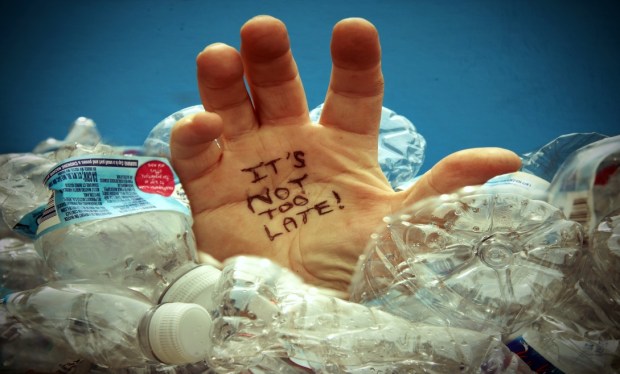
The urgency of the climate crisis situation has reached its peak in the last few months, with the likes of Extinction Rebellion, Greta Thunberg and David Attenborough emphasising the importance of saving our planet for future generations. Many industries and companies have reacted and responded accordingly, introducing sustainable practices and policies to cut down on plastic waste and carbon emissions, and in general to be more mindful of their impact on the environment. The health and beauty chain Boots, for example, are replacing their plastic bags with paper ones and the supermarket, Waitrose, has launched a trial packaging-free option for some foods, with customers encouraged to bring their own containers. Individual choices, such as consuming less plastic and water, are also collectively important.
Courtesy: Boyce Duprey; Flickr
But what about life sciences? Science is well known for environmentally unfriendly practices such as using toxic chemicals and high plastic consumption. Anyone who works in cell/tissue culture will be familiar with the amount of plastic waste generated from a couple of experiments – disposable centrifuge tubes, cell culture flasks and pipette tips are all necessary consumables which are thrown away after a single use. In 2014 it was estimated that 5.5 million tonnes of plastic waste was generated from laboratories in biological, medical and agricultural research facilities. Needless to say, we can and should do more to reduce the amount of waste generated from disposable plastic.
The University of Manchester is among those striving to adopt eco-friendly practices to help scientists do their bit to save the planet. Here are just a few examples.
Courtesy: Sanofi Pasteur; Flickr
Green Impact
The Green Impact programme is an international programme focussing on implementing small practices in everyday activities to help change our environmental behaviour. There are separate versions for office and laboratory teams, with several existing across the University of Manchester, and actions focus on a variety of topics such as waste, lighting, energy and learning. For those who are unfamiliar, there are a series of actions to consider and undertake in an online toolkit. A certain number of actions equate to an award, with ‘Working Towards Accreditation’ the lowest and Gold the highest. Following submission of the toolkit, the lab or office space will be audited by volunteers of the Green Impact programme. It’s normally very informal and nothing to worry about! The programme concludes each year with an award ceremony held in Whitworth Hall to celebrate and award the efforts of all those involved. Being involved in a Green Impact team looks great on your CV, and an award is beneficial when applying for research grants. It’s a great way to help make a difference in your lab as well as get together with your colleagues. If a team doesn’t exist in your lab or department, it’s very easy to set one up!
Carbon Literacy for Labs
The Carbon Literacy Project was designed to help make individuals and organisations aware of the carbon dioxide costs and impacts of everyday activities. Carbon Literacy was developed in Manchester, and The University of Manchester was one of the first in the world to gain Carbon Literate Organisation accreditation. A spin-off of this is Carbon Literacy for Labs, organised by Virginia Harvey based in the Manchester Institute of Biotechnology. This involves a day’s training in how we can implement low-carbon choices and behaviours in the lab. This was first rolled out in October 2018, so signing up now would still make your lab one of the first to be Carbon Literate. Having a Carbon Literate lab looks fantastic for grant applications, and participants of the training gain a Carbon Literacy certificate looks great on CVs. For more information, contact Virginia directly: virginia.harvey@manchester.ac.uk or check out this blog.
Faye vs Abcam
Some of you may be familiar with Abcam, a major supplier of assays and antibodies for life science research. The antibodies supplied are delivered in plastic containers, which are often thrown away or disposed of, as the majority of users aliquot their antibodies. Faye Bolan, a PhD student based in AV Hill, has launched an amnesty campaign for scientists to drop off their Abcam antibody containers for Abcam to recycle. She started the campaign as she found no real purpose for the containers after the antibodies had been delivered. After contacting Abcam via Twitter, Faye started a collection for Abcam to re-use/recycle. The response was overwhelming and to date, 300 containers have been collected!
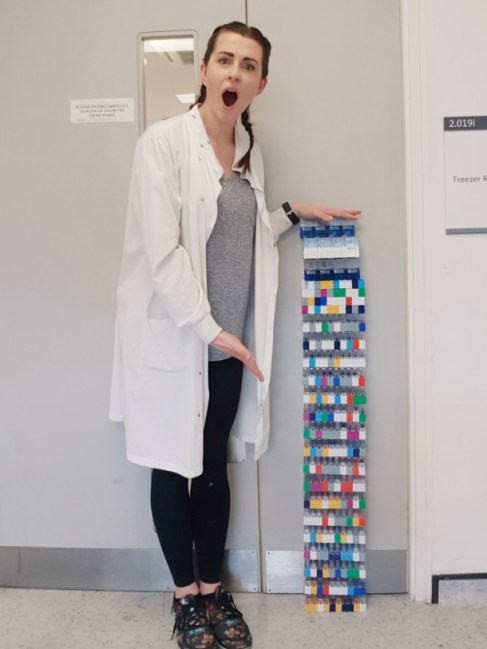
Faye and her Abcam collection. Courtesy: Faye Bolan
As a result of this successful campaign, Abcam have contacted Faye to help provide feedback and comments to new prototypes for more environmentally friendly packaging. It goes without saying that the ambitions and drive of an individual can make all the difference. If you would like to find out more about Faye’s endeavours, please contact her via email: faye.bolan@manchester.ac.uk or via Twitter.
For industries to accept responsibility and change their practices for the climate crisis situation, users need to voice their thoughts and opinions and confront companies head on, such as the case with Faye and Abcam. As more customers place pressure on companies to change their ways, slowly changes can and will be made in order to make the biotechnology industry more sustainable and environmentally friendly. Both individual and group efforts in the lab make all the difference, and although science will never be the most sustainable industry, it’s important that we recognise and respond to the actions we can undertake to make it MORE sustainable.
Written by Helen Clough
Discover more from Research Hive
Subscribe to get the latest posts sent to your email.
 Research Hive