By Jason Chu
This February the MRC DTP Keynote Seminar team invited Dr Marc Milstein to the University of Manchester to talk about sleep and stress. After earning his PhD in Biological Chemistry from UCLA, he continued his research in a range of topics from genetics, cancer, neuroscience and infectious disease. Since then he’s used his scientific training as an internationally recognised speaker on optimising brain health, boosting happiness and productivity.
Have you struggled with sleep in the past year? Have you felt an extra layer of stress and anxiety? Has this global pandemic been frustrating?
You may have answered yes to all three and that’s a common feeling amongst many of us.
How to optimise your sleep
Sleep works in a cycle of three stages: light, deep and REM (rapid eye movement). A total sleep cycle of 90 minutes. Light sleep is the beginning of the sleep cycle as the transition stage between wakefulness and sleep. Deep sleep is when repair and rejuvenation of the brain occurs. Finally REM sleep is an electrical storm of activity to process the things you’ve learnt and the space where we dream.
Sleep is essential for good health. We need it maintain our immune system, consolidate our memories and help clear waste through a nightly “brain-wash”. Our brain almost acts as a sponge for all the waste built up through the day. And at night, the cerebral spinal fluid rushes through to cleanse, where our brain can shrink by 60% to squeeze out the toxins.
Over the last 12 months, the quality of our sleep has not been great.
So how has the pandemic affected our sleep?
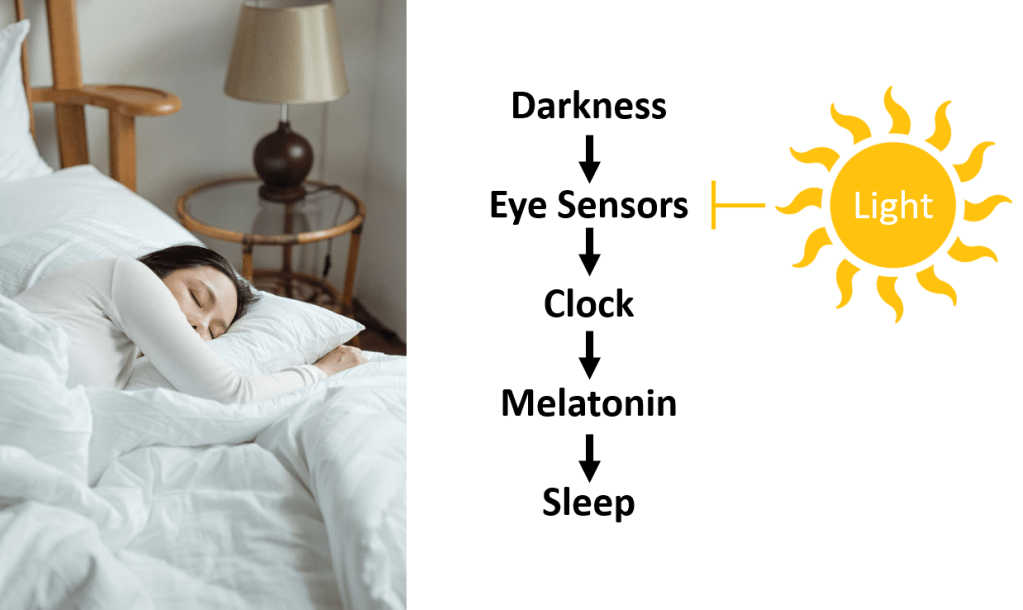
In order to have effective sleep, our brain clock responds to external triggers such as light. When it’s dark, our body produces more melatonin, and this helps us fall asleep. This system is reset with normal daylight, which will inhibit the productive of melatonin. However, how many of us are working from home these days? How many of us have restricted time outside due to lockdowns? Think about how little we have natural light to interact with our brain clock.
Tips on sleep:
- Re-create sunset before sleep, like a dim limp. Your body needs ~30 minutes to create melatonin.
- Avoid blue light (screen-time) before sleep.
- Try make your room as dark as possible. Next time you go to sleep, look around and see how dark it is. Think about digital devices, charging phones, street lights. This is our modern dark. Try minimise these lights as much as possible.
- Make your room cooler – as a lower core temperature is ideal for sleep.
- Have a shower 90 minutes before sleep. Your body seems to warm up, and lower down to the ideal core temperature.
- Create a sleep cue and do something routine before sleeping. This activity will then be associated with the action with sleep coming up next, e.g. reading or Sudoku.
- Journal a to-do list for the next day. This helps trick the brain to not worry about it during your sleep.
- If you wake up in the middle of the night, don’t look at the time. Avoid playing the game of counting down until the alarm goes off.
- When you wake up in the morning, try actively trigger your brain clock. Take a morning walk or go outside for 10 minutes to regulate your melatonin levels.
- Our body clock likes to work with timely cues. Can you time these to be more consistent? e.g. waking up, eating meals, exercise, work commute, bedtime.
- If you’re having a mid-afternoon nap, time it to the sleep cycles, i.e. less than 30 minutes (during light sleep), or longer than 90 minutes (a full sleep cycle).
Stress Management
In an era where wellbeing and mental health is climbing up to a prime spot. We are often told that stress is bad for us, and we need to do things to alleviate this. However, it should be noted that some stress, namely acute stress, can be healthy and beneficial. This gives us a burst of energy and focus to deal with tasks.
What seems to be unhealthy is our growing burden of chronic stress. This can be damaging and related to various long-term health conditions. This prolonged stress response is what needs to be switched off.

Tips on stress:
- Acknowledge the stress, don’t suppress it. Maybe even compartmentalise and schedule time to stress and worry for 10 minutes of the day.
- Mindfulness. It’s all about focussing and limiting our mind wandering (which often leads to negative thoughts). Try this – breathe in “calmness”, and breath out “anxiety”. And do that a few times.
- Mindful eating. We often find ourselves having our meals while watching TV or on our phone. For a few bites of our meals, focus exclusively on the taste and texture.
- Mindful walking or green time. Go for a walk outside, and take out the earbuds and music. For a few minutes, take notice of your surroundings. Name three things you see, smell, hear and feel.
- Doing something you enjoy. Simply focussing on the activity of your hobby. Maybe that’s art, music, writing, or cooking.
- Exercise. Even light activity that gets the blood flowing is great for physical and mental health.
- Do something new. Our brain thrives off of novelty, e.g. a new recipe or walking route.
A huge overhaul is hard work, and more often than not, leads to people giving up on making these improvements. These tips on sleep and stress should be small changes you can try make to better your brain health. Just try one or two, and see how you feel. Our postgraduate research lives are already difficult enough as it is. We should do what we can to look after ourselves.
Hopefully you can have better and more effective sleep.
Night.
Discover more from Research Hive
Subscribe to get the latest posts sent to your email.
 Research Hive
One thought on “Optimising Sleep and Managing Stress”