By Rob Harkness
The 28th of February is Rare Disease Day, where patients, clinicians, scientists and charities come together to raise awareness of the impact of rare disease conditions on individuals, families and health care services.
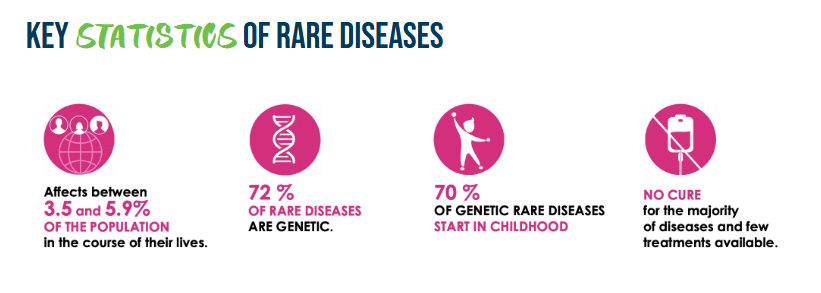
A rare disease is defined as one which affects fewer than 1 in 2000 people. Many of the ~6000 rare diseases are chronic, degenerative, or disabling, and have huge personal, family and healthcare consequences for affected patients. 70% of rare diseases are diagnosed during childhood, but can occur at any point during an individual’s lifetime. Rare diseases vary hugely, with conditions such as Marfan syndrome affecting connective tissues around the heart, eyes, and joints throughout a patient’s life, or Huntington’s disease, which causes gradual degeneration of parts of the brain.
Although each rare disease does not affect many people, the cumulative burden is high, with 1 in 17 people being affected by a rare disease over their lifetime. Healthcare provision for rare diseases is not straightforward, with clinical expertise and patient information relatively scarce. A clinician may only see a handful of cases of any particular disease in their career, if at all. This leads to long diagnostic journeys for patients, and even longer journeys to treatment.
Rare diseases pose an immense challenge to affected individuals and healthcare services. This has led to global organisations such as the United Nations and the World Health Organisation taking an active role in advocating for greater patient recognition and support, and improvement of healthcare and research provision. This includes generating patient information leaflets about each conditions, to help patients inform themselves and their family about how key aspects of living with their condition. The overall aim of the Rare Disease Day campaign is to improve world-wide advocacy for rare disease patients, research, and treatments.
Impact on Patients
The impact of having a rare disease on an individual and their family cannot be understated. A survey by EURODIS, the European rare disease network, identified that 77% of patients and carers reported difficulties completing basic daily tasks (cooking, household chores), and that 2 in 3 patients and carers spent more than two hours a day on disease-related tasks (medication, therapy).
The impact of living with a rare disease on patient and carer professional careers is also stark, with 7 in 10 having to reduce or stop work at some point due to their disease. The impact of rare disease on mental health is also becoming more apparent, with three times more people reporting being unhappy and depressed compared to the general population.
Rare disease networks provide valuable support to patients and families. They play a key role in connecting patients suffering from the same rare disease, bringing them into a community. Few rare diseases have adequate treatments, leaving many patients to live their lives differently, many out of the public eye. This year’s Rare Disease Day aims to improve visibility of rare diseases, and pride for affected patients and families.
Causes of Rare Diseases
Rare disease conditions generally have a genetic basis, with either inherited or spontaneous genetic mutations being the cause of 72% of rare diseases. A genetic mutation, called a genetic variant in the genetics research, is a change in a single letter of the genome, made during the process of copying an individual’s DNA as cells divide.
Genetic variation can have different outcomes. Firstly, a variant can have no effect at all. Some spontaneous variants may fall in parts of the genome which do not code for any particular gene so don’t impact biological processes.
However, some genetic variants lead to changes either in genes, or in the elements regulating genes. This can lead to altered expression, structure, or function of specific proteins. Many variants are the cause of the differences between individuals (such as hair colour or height), and are inherited through different generations, making them relatively common in the general population.
Sometimes, variants do lead to dysfunctional biological processes, and ultimately disease. One well-known example is variants in the gene CFTR, which causes dysfunction to the process of watering down mucus in tissues such as the lungs. This results in a disease is known as cystic fibrosis.
Genetics is key to understanding how rare diseases arise. A key method used in diagnostic labs is whole genome sequencing (WGS), where a person’s entire genome is read. A person’s genome sequence can then be compared to a reference genome sequence, allowing genetic variants to be identified.
In inherited disease, scientists look for the same variant located in the DNA of every affected family member. However, sometimes a patient may not have a history of the disease in their family. In this case, the variant has occurred spontaneously in the patient. Scientists can compare the patient’s genome to their parent’s genomes, and pick out which variants are new. This approach is called patient-parent trio sequencing analysis, and is the cornerstone of modern genetics.
Genetics in Manchester
The Manchester Genomics Hub is a key centre for the 100,000 Genomes Project, a national initiative to sequence the genomes of patients and family members affected by rare disease, or certain cancers. This is part of a UK-wide push to understand the genetic causes to rare conditions, and develop new, quicker diagnostic methods and treatments.
The key to identifying genetic variants which case rare disease is data. The more genomes which are sequenced, the better understanding we have of which variants are rare or unique, and so are likely to cause rare diseases. The extension of this project into the 5 million genomes project by 2024 will allow researchers to look to do more and more sophisticated research, which will ultimately improve the diagnostic process for the rarest of rare diseases.
In Manchester, events are being held to mark Rare Disease Day 2021 include a special recording of the RARE / D podcast, which discusses what it means to be rare, and the research being done in Manchester. To find out more, listen to the previous RARE / D podcasts here.
Discover more from Research Hive
Subscribe to get the latest posts sent to your email.
 Research Hive
One thought on “Rare Disease Day”