BY SUSAN LIMBU

Dandruff is a common scalp condition that affects people of all ages and ethnicities, with more than half of the world’s population suffering from the condition at some point in their lifetime. Whilst some consider dandruff as just an itchy and annoying ailment that occurs once in a while, for some, dandruff can affect their psychological well-being as well as their everyday life. It is also a fascinating condition to research. A combination of different factors contribute to dandruff and with new, emerging research reporting the presence of inflammation in the dandruff scalp.
Why do we get dandruff?
- Changes occurring within the scalp
Whilst the most well-known symptom of dandruff is an itchy scalp, there is in fact more going on than just an itch. Several key factors contribute to dandruff, including the make-up of the scalp’s microbiota. The gut is not the only place in the human body with an interesting microbiota; the scalp also has its own host of mini-residents, including yeast, bacteria, mites and even viruses. In a dandruff scalp, there are crucial changes in the microbiota, including an imbalance of bacterial species [1], and an excess of the yeast Malassezia [2]. These yeast cells consume the sebum produced by the hair follicles, breaking it down to produce by-products which irritate the scalp skin.
The scalp skin, like skin from the rest of the body, consists of three different layers- the epidermis, dermis and hypodermis (fatty layer) (Figure 1a). Taking a closer look at the epidermis, it is made up of 5 different layers with epidermal stem cells present at the bottom of the epidermis. These stem cells differentiate from the bottom to form the terminally differentiated layer called the stratum corneum at the top. Normally, the cells within the stratum corneum shed away without the presence of nucleus. However, in dandruff scalp, the nucleus remains within the cells that are on the top layer of the epidermis. This atypical retention of the cell nuclei is known as parakeratosis, and causes the cells to shed away collectively as flakes [3]. The flakes result from an increase in cell differentiation and termination occurring within the epidermis. Furthermore, the epidermis is thicker and more convoluted in a dandruff scalp [4] (Figure 1b).
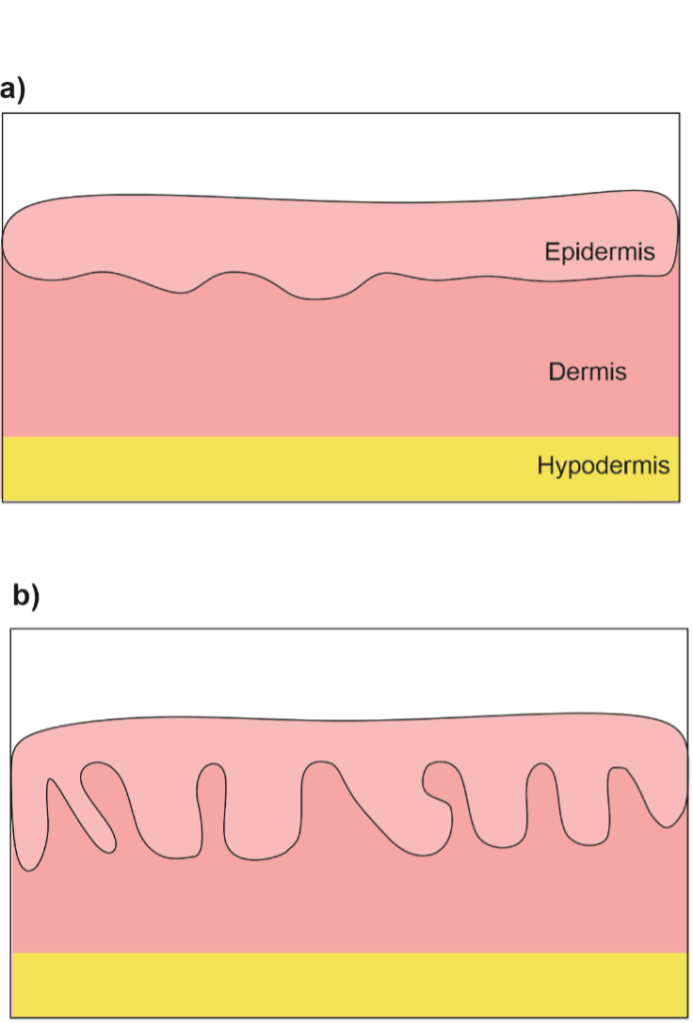
Figure 1: A graphic diagram of normal verses dandruff skin. a) In healthy scalp, the thickness of the epidermis is normal in comparison to (b) in dandruff scalp, where the epidermis is thicker and more convulated.
2. Changes in the epidermis
There are also changes in the composition of lipids and proteins within the epidermis which leads to the scalp skin barrier being weak and leaky. This leads to greater water loss across the scalp skin and weakening of the epidermal barrier.
3. Stress and environmental factors
Emotional stress has been shown to contribute to dandruff as it weakens the immune system causing Malassezia yeast to thrive and multiply further [5,6]. Environmental factors such as low humidity has been shown to worsen dry scalp and increase dandruff [7].
4. Emerging research in dandruff: Inflammation of the skin
For much of the history of dandruff research, yeast and its impact on the scalp skin has been the main focus of investigation. Inflammation was mostly not considered, with the dandruff scalp reported to have no inflammation. Inflammation is known to be caused by several different things such as the presence of pathogens (i.e: fungi and bacteria) and damage at the site of inflammation. This leads to the involvement and presence of immune cells at the site of injury tissue.
With emerging research on the immunological aspect of dandruff, dandruff scalp is now reported to have mild inflammation with the presence of immune cells within the dandruff scalp There is also an increase in epidermal inflammation markers within dandruff scalp such as IL-1a, IL-1RA and IL-8 [8, 9]. Since the specific cause of the inflammation is unknown within dandruff, it would be interesting to find the mechanism behind the inflammation and the specific immune cells that are involved, which might be significant for future treatments.
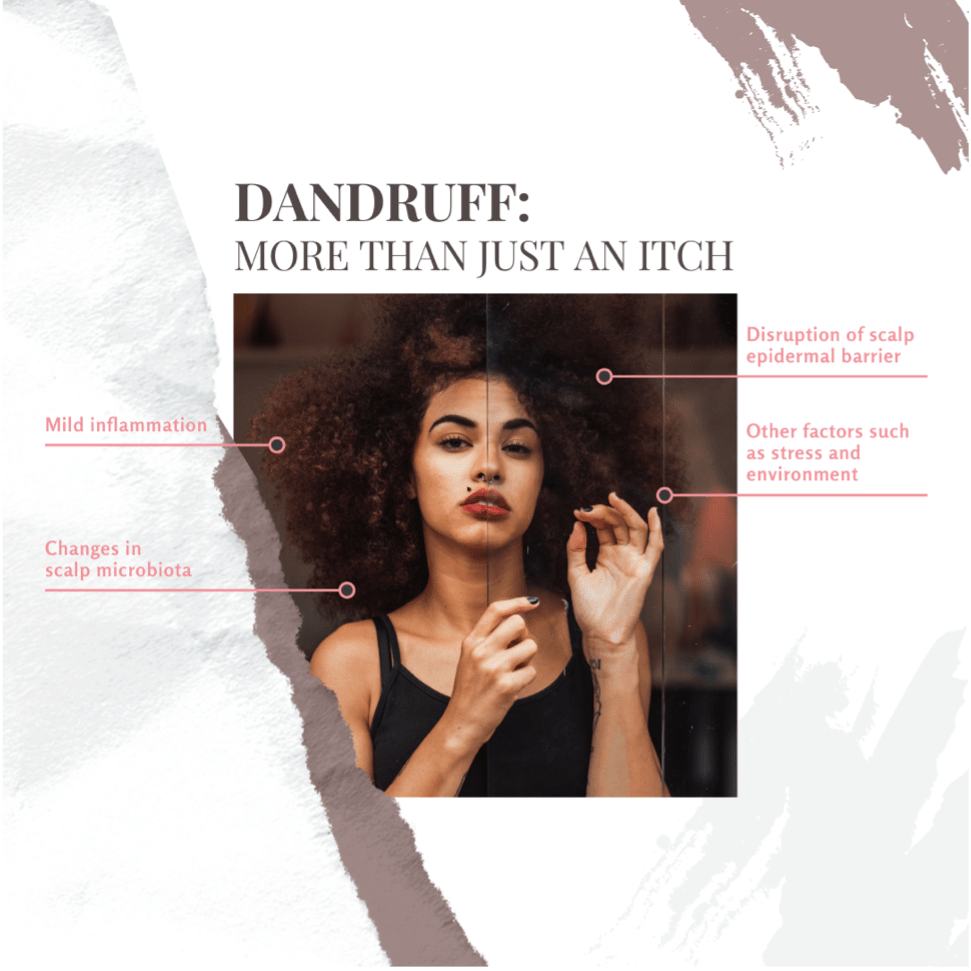
Infographic summary of factors involved in dandruff by: Isabel Rivera (Instagram: @howmanybells)
Treatment for dandruff
Currently, most anti-dandruff shampoos target the Malassezia yeast with the aims of reducing flakes and itchiness, and restoring the scalp back to normal. One of the effective ingredients in anti-dandruff products is zinc pyrithione which is known to inhibit the yeast Malassezia in dandruff scalp. Rather than just targeting the yeast, going forwards, the possible targets for dandruff treatment should include the balancing of bacterial species in the dandruff scalp as well as improving the epidermal barrier and reducing inflammation
References
- Saxena, R., Mittal, P., Clavaud, C., Dhakan, DB., Hegde, P., Veeranagaiah, MM., … Sharma, VK. (2018). Comparison of Healthy and Dandruff Scalp Microbiome Reveals the Role of Commensals in Scalp Health. Front. Cell. Infect. Microbiol., 8
- Xu, Z., Wang, Z., Yuan, C., Liu, X., Yang, F., Wang, T., … Zhang, M. (2016). Dandruff is associated with the conjoined interactions between host and microorganisms. Sci. Rep., 6, 24877.
- Turner, GA., Hoptroff, M., Harding, CR. (2012). Stratum corneum dysfunction in dandruff. Int. J. Cosmet. Sci., 34, 298–306.
- Pople, JE., Bhogal, RK., Moore, AE., Jenkins, G. (2019). Changes in epidermal morphology associated with dandruff. Int. J. Cosmet. Sci., , ics.12539.
- https://happycappyshampoo.com/dandruff-relief/does-stress-cause-dandruff/
- https://www.nizoralshampoo.co.uk/blog/posts/2020/may/interview-with-a-trichologist-dandruff-explained
- https://www.nioxin.com/en-GB/caring-for-your-hair/scalp-care/stress-and-dandruff
- Kerr, K., Darcy, T., Henry, J., Mizoguchi, H., Schwartz, JR., Morrall, S., … Mills, KJ. (2011). Epidermal changes associated with symptomatic resolution of dandruff: biomarkers of scalp health. Int. J. Dermatol., 50, 102–13.
- Mills, KJ., Hu, P., Henry, J., Tamura, M., Tiesman, JP., Xu, J. (2012). Dandruff/seborrhoeic dermatitis is characterized by an inflammatory genomic signature and possible immune dysfunction: transcriptional analysis of the condition and treatment effects of zinc pyrithione. Br. J. Dermatol., 166, 33–40.
Discover more from Research Hive
Subscribe to get the latest posts sent to your email.
 Research Hive
One thought on “Dandruff: more than just an itch”