By Faye Bolan
For those of us wanting to explore future careers outside of academia, the options we come across during our PhDs can feel limited. Jobs in industry, medical writing or teaching are well-trodden paths but there are a variety of other careers that need the unique mix of skills and attributes that a PhD equips us with. If like me you’re excited by the prospect of stepping our of your comfort zone by broadening your area of research, then policy-based research could be an option. In this context and fresh from completing a three-month research fellowship at the Parliamentary Office of Science and Technology (POST), I wanted to share what I’ve learnt about research for policy in the heart of the UK Parliament and how this style of research differs from the more familiar world of academic research.
What is POST and what does it do?
First things first, let’s clear up some terminology. The difference between parliament and government is often confused, if my family asking “How is the government placement going?” is anything to go by!
The UK government is made up of the elected Prime Minister and the Members of Parliament (MPs) they select as cabinet ministers (see diagram below). Government creates and enacts policy via the ministers and civil service staff of the departments e.g., Department for Health and Social Care. Parliament, well parliament is everybody else! This includes so-called back-bench MPs (those not in ministerial positions), opposition MPs, members of the House of Lords and all the parliamentary staff who work for them. Parliament’s role is to scrutinise government policy, such as through debate or proposing amendments.

‘Policy research’ is another confusing phrase, with different meanings depending on the context. To distinguish, there is:
- Research on policy. Research that evaluates the effect of a particular policy (international, governmental, institutional) on a given outcome. For example, research on the effect of the 10p plastic bag charge on single-use plastic use in the UK.
- Research for policy. Research that is intended to inform policymakers and increase the use of evidence in decision-making processes. For example, a briefing summarising current research on artificial intelligence in healthcare.
POST primarily conducts research for policy within UK Parliament. Evidently, we want policymakers to make important decisions based on high quality evidence-based research. However, we know that academic literature in any field uses jargon that is inaccessible to most readers, including our elected representatives. This is where POST comes in, acting as an intermediary to bridge research and policy. POST translates academic research into a form that is accessible to policymakers and aims to inform parliamentarians with the best available evidence on science, technology and social science topics of current policy importance, enabling them to scrutinise government policy in an informed manner. As POST serves parliamentarians of all parties within both the House of Commons and the House of Lords – their research outputs are impartial, balanced and do not make policy suggestions.
POST’s main outputs are short four-page briefings, so-called POSTnotes, which summarise evidence on a topic and identify areas for policy consideration. As an example, here’s my POSTnote on distance learning (shameless plug!). Since the start of the COVID-19 pandemic, POST have also been busy publishing a number of rapid response briefings on topics such as COVID variants and vaccine safety.
What are the key differences between research for policy and academic research?
While research for policy and academic research require many of the same skills, during my fellowship I observed five key differences between the two styles of research, summarised below:
- Pace: Research for policy moves at a much faster pace than academic research, adapting and responding to emerging topics of interest. For example, the turnaround time for researching, writing, peer-reviewing and publishing a POSTnote brief is three months and is even quicker for other rapid-response outputs.
- Research Methods: The biggest observed difference is in how evidence is collected. Literature reviews using research databases are common to both styles of research but interviews with key stakeholders are also used in research for policy. Interviewees include academic experts, as well as representatives from relevant charities, other third sector organisations, industry and government. Balancing the voices of various interest groups can be a challenge with this type of research, particularly if the subject matter is controversial or raises politically partisan issues.
- Types of Literature: Depending on the subject, the type of literature used may vary from academic research. In addition to primary research, research for policy typically makes use of more grey literature, which includes reports from charities and policy think tanks, as well as outputs from government or parliament.
- Tone and Audience: As research for policy typically has a broad target audience, the writing should be clear, concise and complex jargon should be avoided. For example, POST’s work aims to be comprehensible by an ‘educated lay audience’ and POSTnotes should be easily read over a coffee break!
- Framing: In addition to presenting research evidence, research for policy also describes any current policy relevant to the subject and identifies issues for future policy consideration. The final and potentially trickiest difference for details-oriented academics to adjust to, is that while accurately conveying research findings to policymakers is key, clearly making the case for why they should care about a topic and its wider relevance to society is more important than the nitty gritty scientific detail.
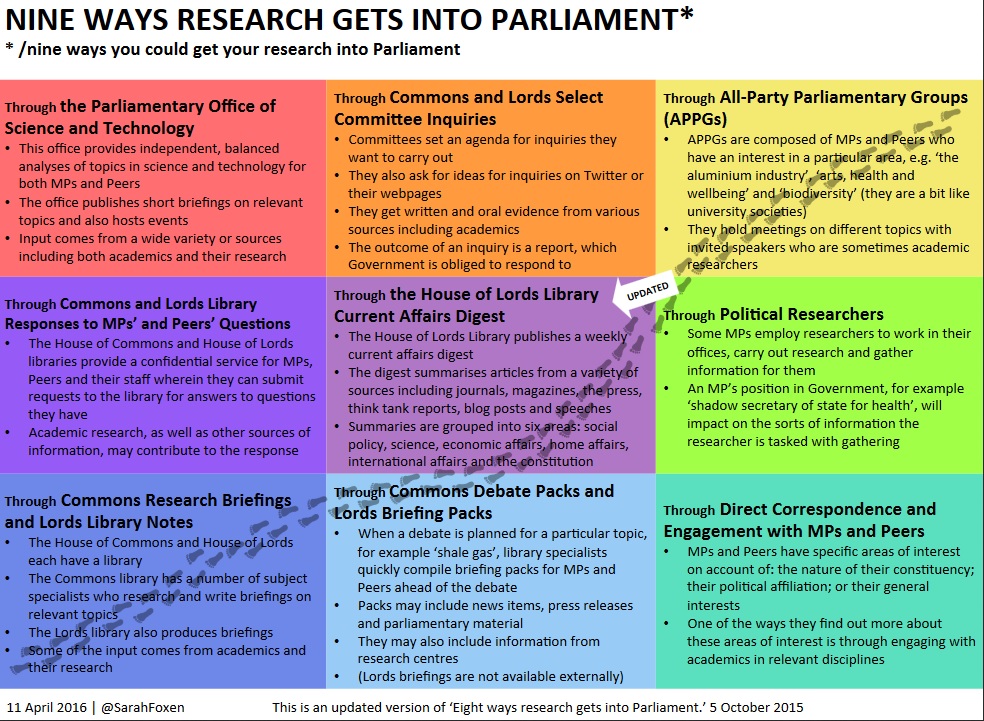
There are numerous ways academic research flows into the parliamentary decision making process (see this handy diagram outlining the 9 ways research flows into parliament), with POST being just one of them. PhD level (and above) researchers can be found throughout UK Parliament, where their ability to conduct thorough research, critically appraise literature and clearly communicate findings help to ensure policy decisions are made based on robust evidence.
Many of the most critical societal issues we face are fundamentally scientific in nature, whether it be COVID-19, climate change, ageing populations or growing scientific disinformation. Having researchers fluent in the language of academic research at the heart of decision-making processes will be vital for tackling these challenges in the coming years.
Fancy giving research for policy a go? POST advertises three-month fellowships for PhD students throughout the year and more information about individual fellowships can be found here.
Discover more from Research Hive
Subscribe to get the latest posts sent to your email.
 Research Hive