
Insights from a Summer School in Digital Health and Preventive Healthcare
Author: Bibhusha Karki // Editor: Karabo Sibasa
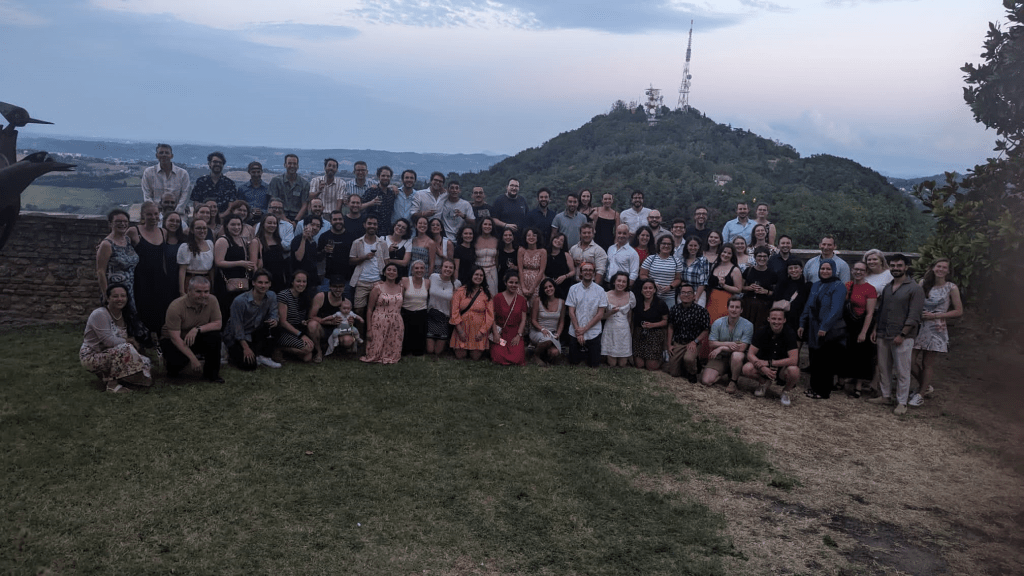
In early August, some PhD students and post-doctoral staff from the Faculty of Biology, Medicine and Health (FBMH) were competitively selected for an opportunity to attend a summer school in Bertinoro, Italy. Organised by The Mobilise-D consortium and the Italian DARE Initiative, the summer school focused on creating a multidisciplinary learning opportunity for digital technologies and preventive healthcare. The goal of the summer school was to help attendees understand the power, structure and stakeholders involved in integrating digital tools to improve health outcomes through disease prevention, intervention monitoring, and personalised healthcare. I was amongst those lucky ones who got to experience this summer school. It was also my first international PhD trip.
Like the multi-disciplinary nature of the Mobilise-D consortium, the attendees were all from diverse career stages and backgrounds, such as technology, clinical research, health sciences, pharmaceutical industries, and economics. There were around 30 speakers who also ranged from equally diverse backgrounds, such as health sciences, technology, global policy, local policy, law and user experience. Jane Mcdermott, from FBMH at UoM and Lis Boulton, former researcher from FBMH were also amongst the speakers. The majority came from various countries of Europe and the United States. The summer school was like the bike frame of a cycle that created the foundation that united this multidisciplinary group. Then, together, we went on this journey of learning, exploring, and making memories.
My research aims to co-develop a digital health program called Keep on Keep Up (KOKU) for older community-dwelling South Asians to help increase their physical activity and improve health outcomes. Dr Emma Stanmore, Dr Charlotte Eost-Telling, and Dr Jaheeda Gangannagaripalli from FBMH supervise my research. People often assume I have a highly technical background when I mention my research. They tend to be surprised when I state my social science background- international development, economics, and public policy. Their expressions often question, “Are your skills even useful in technology?”. I would then explain that minority communities have often been excluded from economic stability, access to quality education, healthcare, and accessible infrastructure and environments, leading to digital uptake barriers. These factors all lead to issues of digital inequity and AI bias. My skills would help create inclusive solutions in the user experience side of technology. As I get the nod of understanding and possibly being allocated into a box from my listeners, my inner voice would say, “This is more than user experience; it is about representation and belonging.”
To begin, this summer school showed that technology creation is only one of the important steps towards digital health. The most important step is understanding the complexity of the health ecosystem, patients, doctors, clinical trials, businesses, pharmaceutical agencies, healthcare agencies, technology, communities, law, and policies (local, national, and international) are all key to creating a successful innovation. It involves a deep understanding that juggling the health ecosystem and its stakeholders is a messy circular framework, almost like a child’s disordered circular drawings.
To paraphrase one of the speakers, Harold Wolf: “We already have technology; it has taken mankind to Mars, but I was not able to transfer my health records to a new provider across the street from my previous provider.”
Secondly, multidisciplinary collaboration can be a way to decode the complexities of the health ecosystem. We got to work in a group, setting to create innovative solutions for improving health outcomes with our multidisciplinary teams. I realised that the benefit of a multidisciplinary team is that one does not need to have all the answers to everything and that we can rely on each other’s expertise. However, the challenge of a multidisciplinary team is that individuals from each discipline tend to “see” from the perspective of the training they have received. Almost like the story of The Blind Men and the Elephant, where a group of blind men try to discover what an elephant is. Each person touches a different part of an elephant and disagrees with the other. Working in a multidisciplinary team can only be successful if we have the necessary soft skills, including interpersonal skills, communication, problem-solving, and time management.
Thirdly, the discussion of Artificial Intelligence (AI) was also fascinating. It was interesting to know that AI being honest about its capabilities or limits might be the way to bridge any trust gaps and ensure the ethical use of Al. For the first time, when Siri admitted that it did not understand my questions, possibly due to my accent, it made me happy. It was refreshing to know that the ability to admit the limitation of one’s knowledge is equally essential for both human beings and technologies.
Following that, the discussion around user experience and public patient involvement (PPI) was also insightful. The key to a successful user experience is more than just focusing on the techniques to get answers. Still, it ensures that every participating individual feels respected throughout the process and that little details are taken care of. For example, when choosing a venue to conduct user experience or PPI, making it as accessible as possible (disabled parking, free parking, step-free access, availability of childcare, flexible meeting times, some compensation to the community) and other various factors would make a substantial influence in participants’ willingness and ability to participate.
Finally, summer school also involved a lot of fun activities that helped build collaboration and a foundation of long-lasting friendships. This made me realise that trying to make the world a better place is hard; we need lighter moments to build one’s capacity to be changemakers.
In conclusion, I realised that the softer skills – interpersonal, communication, empathy, the ability to be honest with one’s limitations, attention to detail, and the ability to keep things light are some skills that could be overlooked. However, they are as equally important as the technical skills in digital health technology to improve health outcomes.
Discover more from Research Hive
Subscribe to get the latest posts sent to your email.
 Research Hive