Author: Nompumelelo Maringa // Editors: Cherene de Bruyn & Sarah Charlin Klingberg
THE PAST
I have had an interest in history, archaeology and the environment for as long as I can remember. I cherished being outside, playing with plants, gardening, watching insects forage for food or tunnelling a new home in the soils of my home garden. When indoors, I was fascinated with the documentaries on Discovery Channel or National Geographic carefully narrating the interactions of animals in the wild, the history of ancient civilisations, coverage of natural disasters and the changes in the environment. As a child, my only exposure to African Archaeology was the documentaries on ancient Egypt, the pharaohs and the pyramids and a little bit on the hunter-gatherer societies in Southern Africa. Little did I know that there was so much more to be uncovered about African Archaeology and the significance it held for human ancestors.
To pursue this interest, I attended the University of the Witwatersrand, Johannesburg, where I majored in Geography and Archaeology. Archaeology in South Africa is a small and competitive field. And yet, forming my passion into a career is a decision I don’t regret. The skills I developed in archaeological excavation, along with the experiences of travelling and visiting African archaeological sites with my fellow students, and the knowledge I gained about Africa’s past throughout have shaped me into a passionate researcher. These experiences opened my mind to new possibilities, and I was excited to forge a new path ahead as an academic, an archaeologist, and an explorer. However, finding a route on this unchartered territory was new to me as well as to my family. It’s not easy being the one in the family who pursued a nontraditional career in academia as opposed to other more commonly pursued opportunities in medicine, commerce or teaching. It was something new for all of us, but I am fortunate to have received support from family and friends to see what this opportunity could yield and where it could take me.
In my last year of undergrad, I started to think more about my future and whether I wanted to continue with academia or do something different. I was determined to pursue academia and incorporate the connections between humans, animals, and the environment. I knew that I wanted something different than what was commonly studied in archaeology at my university and possibly in the country. That’s when I realised that working on micromammals –micromammals refer to mammals with a mass less than 1000g during adulthood such as mice, rats, moles, shrews, mole rats and bats– was something I would like to try. I got the opportunity to research micromammals from Klasies River to reconstruct the environmental conditions that took place around 110,000-115,000 years ago. Klasies River main site is an archaeological site and a recognised National Heritage site located on the Tsitsikamma coast in the Eastern Cape Province, South Africa. The site consists of a cluster of caves and overhangs at the main site and three other caves located east of the main caves. The main cave cluster has provided archaeologists with valuable insights into the lives of anatomically modern humans (Homo sapiens) during the South African Middle Stone Age. A number of well-preserved artefacts have been excavated from this site, such as stone tools, human and animal fossils, shells and charcoal.
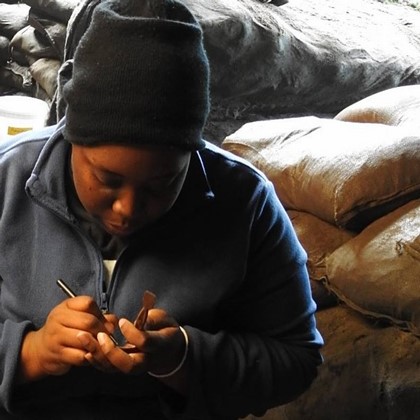
I chose to study micromammals from Klasies River because it was something different for me, and not a lot of researchers were studying this at the time because the main focus was on large or medium-sized animals. This choice also meant that I would be challenged and able to gain a scarce skill. Developing specialised skills as a research student is crucial, yet it’s something not everyone considers early on. As time went on, I completed my honours degree, and I went on to pursue my master’s degree at the same university, working on the same site with material from a different layer, a similar age but with a larger assemblage. This gave me the opportunity to work on the material that I didn’t get to work on with my previous degree and expand my skills in this discipline.
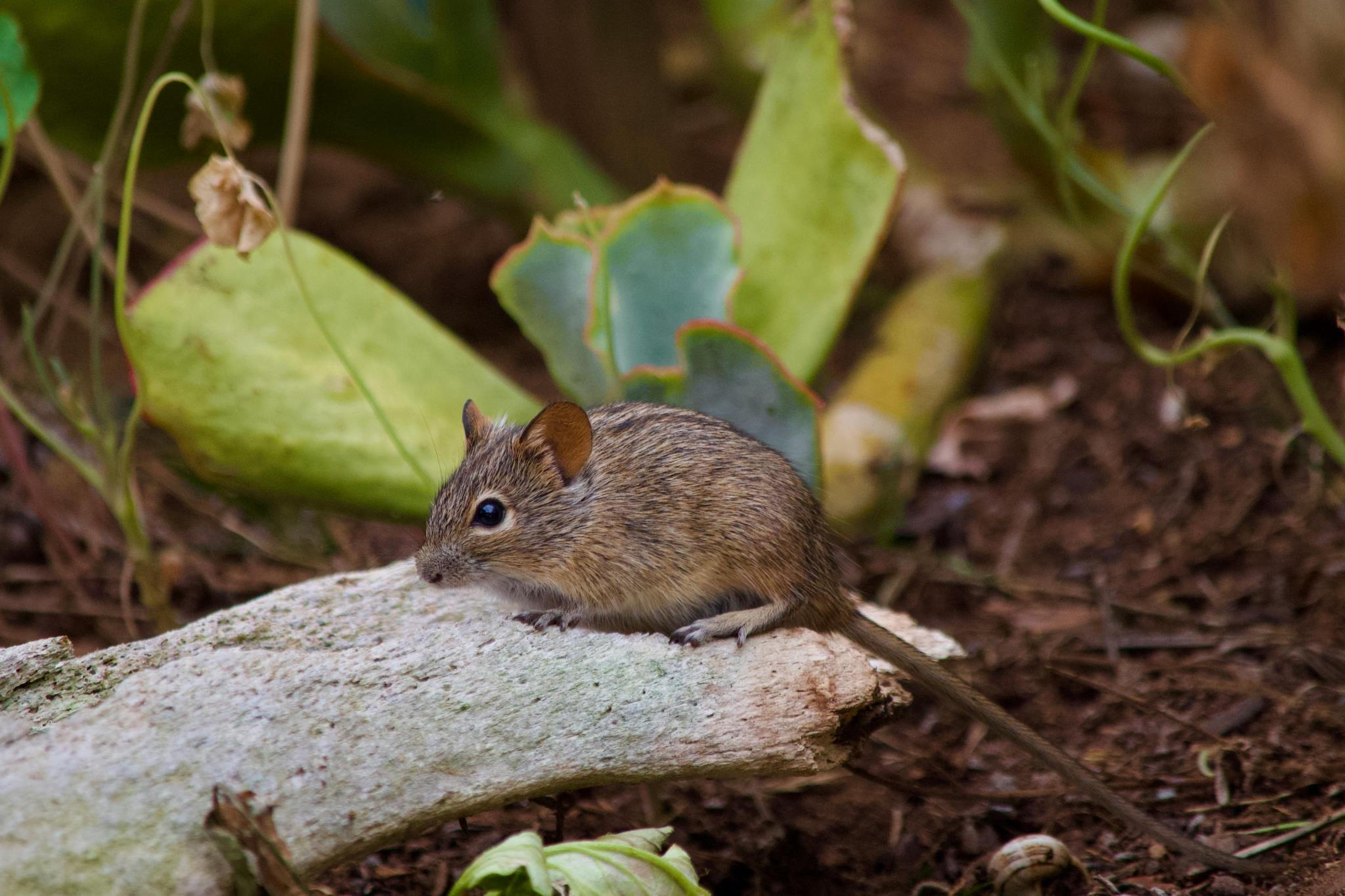
I completed my master’s degree during the global COVID-19 pandemic, so I took a break from academia and started to look for work. It didn’t happen immediately, but I got a job working as a research assistant at Genus Palaeosciences, where I got to apply my research skills. I thoroughly enjoyed working as a research assistant, and I started to notice the growth this opportunity brought upon me. I also started to warm up to the idea of pursuing a PhD, but some things had to be different if I wanted to do it within the next few years. Pursuing a PhD is a big commitment, so to ensure I got the most out of the experience, I began to think about the essential elements I wanted my PhD program to have. I created a set of criteria, almost like a PhD checklist, to help me make a well-informed decision for this next step and start the process of becoming a well-rounded researcher. Some of my criteria were non-negotiable, while others had a bit of wiggle room. My criteria included:
- Funding: Having a full scholarship or full bursary for the research I want to pursue.
- Expertise of Supervisory team: Working with an expert in micromammals as a supervisor or an advisor.
- Research Project: Working on material from an African site within the Middle Stone Age or Early Stone Age.
- Location: Studying abroad.
- Researcher Development: I also wanted an opportunity where I’d be able to explore more skills and expertise, like doing experiments or something to do with stable isotopes.
- Facilities: Being at an institution that has the necessary equipment and lab space for me to do my research efficiently.
- Support and wellbeing: Being in a healthy and friendly working environment.
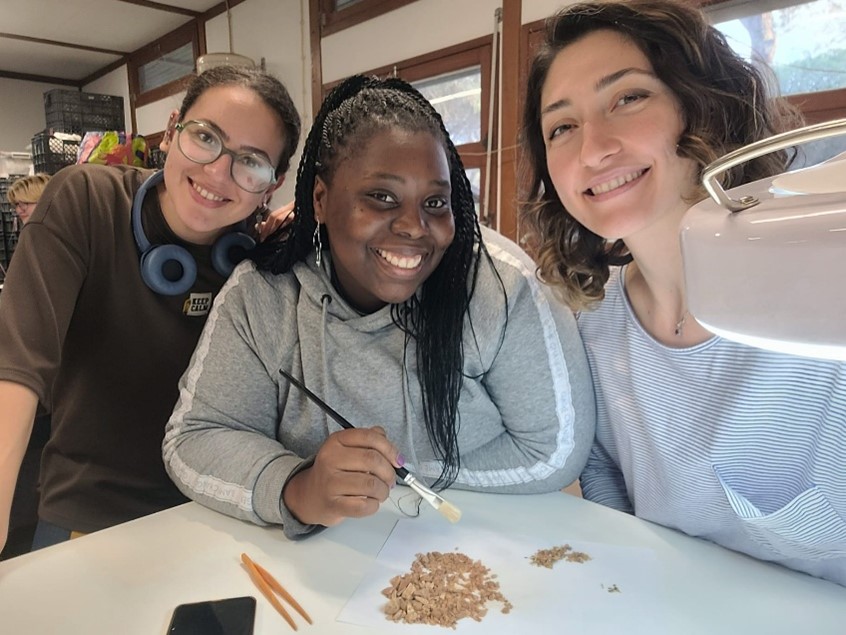
Left to right: Kahina Tetbirt, Nompumelelo Maringa and Inci Özüdoğru. Photo credit: Inci Özüdoğru
For my previous qualifications, I didn’t consider some of these things, which doesn’t mean I didn’t benefit or learn anything, but I do think I missed some opportunities for professional growth. To ensure both professional and personal growth, I knew I had to think differently this time. In order for me to expose myself to better opportunities and be someone I can be proud of, I had to move out of my comfort zone. It was not an easy decision to make because you don’t know your fate until you take a step forward.
THE PRESENT
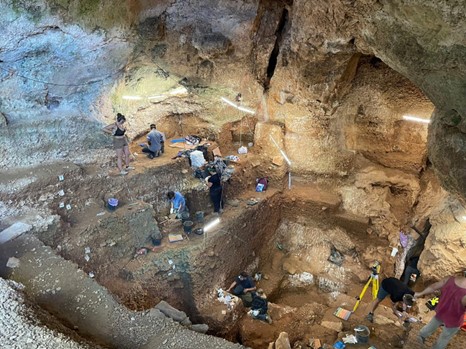
I took an opportunity that met 5/7 of the criteria I set for myself and started my PhD in Portugal at The Interdisciplinary Center for Archaeology and the Evolution of Human Behaviour (ICArEHB) at the University of Algarve, Portugal. As part of the European Research Council-funded Finisterra project, my research focuses on using micromammal fossils to reconstruct the environmental conditions at Lapa do Picareiro, a Middle Palaeolithic cave site that was occupied by Neanderthals and Anatomically Modern Humans between 38,000 and 50,000 years ago. The cave has been excavated since 1994, and a variety of artefacts like bones, shells, charcoal and stone tools have been recovered. Another interesting fact about my research is that this will be the first study to use micromammals to infer the palaeoenvironmental conditions at the site during the abovementioned time frame. Currently, I am analysing the teeth to identify the species of micromammals. Once I identify the species, I can then determine the kind of habitats that they lived in, like cold, warm, forest, wetland, steppe, and if they preferred dry areas or places with lots of rain. I also look at the condition and preservation of the bones and how they have changed over time (for instance, have they broken, become discoloured or polished etc.) or if they were digested. This information tells me about the predators that consumed the micromammals and how their remains were deposited in the archaeological record. So far, I am learning a heap of information about the Iberian micromammals, Neanderthals, Anatomically Modern Humans and the environment. I am lucky that I work alongside a friendly and supportive community of students, researchers and staff members here at ICArEHB. My experience so far has been challenging (like all PhD research) but truly rewarding. I have attended training workshops, and international conferences, expanding my research network, participated in excavation campaigns of two Portuguese Neanderthal cave sites, attended events that inspired me and made discoveries about myself and my research that continue to encourage me to persevere and to pursue my doctorate.
TAKING THE LEAP: YOUR FUTURE AWAITS
As I look back on my academic journey, I can honestly say that pursuing a PhD has been a rewarding and transformative experience. There are challenges—moments of doubt, long hours, and unexpected hurdles—but every step of the way has taught me more about my field, my resilience, and myself. If you’re thinking about taking the plunge into a Master’s or PhD program, I encourage you to take that first step. It might feel intimidating at first, but the rewards of intellectual growth, personal development, and the sheer satisfaction of contributing to something larger than yourself are immeasurable. The journey may not be easy, but every challenge you face will help you grow stronger, more capable, and more confident in your abilities.
Remember, the best time to begin is now. Your curiosity, passion, and drive can shape the future, and there’s no better investment than in your education. So, take the chance and embrace the unknown. The path ahead may not always be clear, and the conditions will not always be smooth, but one thing is certain: You will come out the other side more prepared, more fulfilled, and more ready than ever to make an impact. The world needs your ideas, your voice, and your expertise. Don’t wait for the “perfect” moment—take the initiative and create it. You got this!
About the Author Nompumelelo Maringa is a zooarchaeologist. She studied archaeology from her Bachelor’s to Master’s degrees at the University of the Witwatersrand in South Africa and is currently pursuing her PhD degree at the University of Algarve in Portugal. As an archaeologist, she enjoys exploring the connections between humans, animals and the environment because you get to uncover a story that was never told.
Discover more from Research Hive
Subscribe to get the latest posts sent to your email.
 Research Hive
beautiful text and wonderful life experience. I wish you the best. Miguel
LikeLike