
Author: Precious Chiwara // Editors: Cherene de Bruyn & Sarah Charlin Klingberg
My journey to pursue a PhD in palaeosciences, specifically archaeology, started in 2021 when I received the Human Evolution Research Institute (HERI) #Advancing Woman Award for black female students at the University of Cape Town in South Africa. This #Advancing Woman program was launched by HERI as an initiative to support black women in achieving their career goals. As I kickstarted my PhD, I experienced some challenges, but due to my incredible support system, passion for palaeosciences, and grit, I was determined to overcome any obstacles.
PALAEOSCIENCES – an interdisciplinary study of ancient environments, life forms, and human evolution, using evidence such as fossils, sediments, and artifacts to understand the earth’s past and human prehistory
Pursuing a PhD is challenging, and many students experience similar hardships and obstacles. However, for black women in palaeosciences, some of these hardships and obstacles are particularly challenging considering that historically, the field of palaeosciences has been dominated by perspectives of white men, meaning perspectives of very few women and nearly none from black women are present in academic discourse. It has been my experience that the journey to pursue a career in archaeology, similar to other scientific fields, often comes with resistance, bias and the need to justify ideas to even get basic consideration. Despite these challenges, as a black woman in archaeology and palaeosciences, I have carved out spaces for myself, pushed boundaries, and had many sleepless nights working on my research with countless cups of coffee while also contributing and reshaping my field with new perspectives and innovative research. Of course, I did not do this by myself. I had the support of my supervisors, who kept on pushing me to strive against all odds, and the support of my funders (HERI, GENUS and IFAS), who were chipping in financially to ease the burden. I also worked in a research group that provided a safe space for women, further lessening the weight and academic pressure. However, the outside scientific world can be draining, especially considering how ideas from black female students are perceived and often challenged.
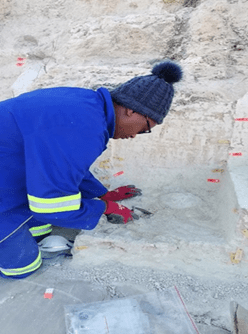
The weight of proving yourself
From the onset, women of colour in scientific disciplines find themselves in a situation where they have to work ten times harder for their work to be recognised while also facing challenges due to sexism. There is often an unsaid expectation to constantly prove one’s competency as a researcher. Ideas that may be acceptable when presented by other peers can be met with cynicism if presented by black women, requiring extensive justification and additional evidence to prove research data and arguments. Even when it comes to publishing, there is often doubt that black women can publish impactful research in international journals with high impact factors. This highlights the need for change in academia so that the scientific contributions made by black women are recognised and given the credit they are due. As a PhD student, I have had first-hand experience of peers doubting my potential and contribution to science, when it was commented that “We doubt her work would be accepted in this good journal”. This continuous need to validate one’s expertise can be daunting and exhausting, but to me, it cultivated resilience, the need to work harder, to be precise and to be as careful as possible in research and everything that I do. But even in resilience, impostor syndrome sometimes creeps in during the journey. Having mentors who shared similar experiences with me helped a lot in dealing with imposter syndrome during my PhD journey.
Navigating resistance to diverse perspectives
As a black woman, I often had to deal with resistance, especially when I present ideas that challenge long-standing narratives in my research area. Women also face resistance if they present narratives that challenge long-standing patriarchal magnitudes in palaeosciences. This can be witnessed in presentations where others dismiss new interpretations that challenge old narratives, some of which current data and new research cannot test. But I wonder, if these ideas had been presented by someone else, if they would have met the same resistance as those given to black women. But these can be overcome by reshaping the field for the future black female scientists.
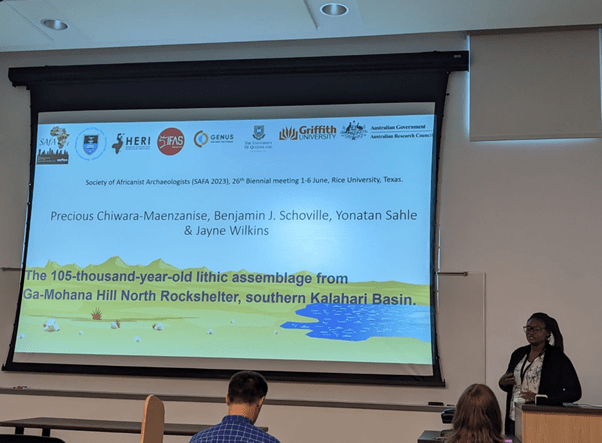
Reshaping the field for future black female palaeoscientists
There is a need to create a strong support system for black women in palaeosciences. This may include connecting with other women in the discipline. As women, we share the same experiences and biases in a field that has been traditionally dominated by men and patriarchal narratives for a very long time. Hence, partnering and collaborating with fellow women from diverse backgrounds and multidisciplinary scientific fields, as well as fellow black people, will create a sense of belonging and solidarity. Secondly, black women can seek mentors who can truly support them in their PhD journeys and those who advocate for diversity and inclusivity in academia. Lastly, prioritising self-care was really important for me as l took care of my mental and emotional well-being during my PhD journey. Despite all these challenges, I believe that black women in southern Africa are making significant scientific contributions and important strides to decolonize and transform previous patriarchal narratives in the palaeoscience and fostering a safe space that is inclusive.
As a researcher, my personal goal is not only to survive the PhD experience but to also help, influence and inspire fellow and future students. As more black women join the palaeosciences, the discipline will benefit from more nuanced and critical perceptions that challenge the status quo. More importantly, by sharing our personal experiences and voicing the challenges and biases we face, we continue to shed light on those serious issues within academic and scientific fields like palaeoscience. I hope that my experience and my voice can encourage others to push forward and inspire them to persevere until the road becomes less rocky.
Furthermore, palaeosciences and other fields like archaeology have been influenced by various Eurocentric interpretations of the past that are currently being challenged within academia. The innovative research and scientifically backed perspectives of African-led research projects should not be ignored and should play a central role in decolonizing discourses and challenging outdated colonial literature. The career opportunities for black women are also growing. Most institutions now practice inclusive hiring practices. In addition, there is also increased visibility of black women now, and funding bodies have developed practices where a certain portion of funding is designated to female scientists, specifically in STEM. This means more opportunities and doors are opening up for women in the palaeosciences. My final thoughts are that navigating a PhD as a black woman is not without challenges, but despite these, it is a chance to break barriers and leave a long-lasting impression in palaeosciences. For those embarking on this path, your research, voice, contribution and presence in palaeosciences matters. Keep pushing and moving forward. The discipline needs your outputs and vision for a more inclusive and fair representation.
About the Author: Precious Chiwara, also known as Precious Chiwara-Maenzanise, is a GENUS Postdoctoral Fellow at the Human Evolution Research Institute (HERI) and the Department of Geological Sciences at the University of Cape Town. In 2021, she received the HERI #Advancing Woman Grant for Black women in palaeosciences, as well as the GENUS and IFAS PhD grants, which supported her doctoral research at the University of Cape Town’s Archaeology Department. Her postdoctoral research has been funded by GENUS, IFAS, and the Palaeontological Scientific Trust (PAST). Both her PhD and postdoctoral work focus on understanding Middle Stone Age (MSA) human adaptation in the Kalahari Basin. She is part of a team highlighting the early record of human evolution beyond coastal regions, where most research has traditionally been concentrated. Precious states, “Black women are underrepresented in palaeosciences; thus, my goal is to advance the representation of women in this field.”
Discover more from Research Hive
Subscribe to get the latest posts sent to your email.


One thought on “Thriving against all odds: Navigating a PhD as a black woman in palaeosciences”