Author: Erin Pallott You know the feeling. That scratch starts in the back of your throat, your whole head hurts, and only one nostril is working. Great, you’ve got a common cold. A first-class ticket to snot city. When you hear the word 'mucus', this is probably the first image that comes into your head. … Continue reading MUCUS! (Finish your lunch first)
Category: Biology
The human placenta: the most successful organ transplant
By Chloe Brady Throughout pregnancy, the fetus (consisting of both maternal and paternal genes), must evade the maternal immune system. For this reason, the fetus has been previously described as the most successful organ transplant, tolerated by the mother for around 40 weeks. In the 1950s, biologist Sir Peter Medawar first recognised that pregnancy is … Continue reading The human placenta: the most successful organ transplant
Rare Disease Day
By Rob Harkness The 28th of February is Rare Disease Day, where patients, clinicians, scientists and charities come together to raise awareness of the impact of rare disease conditions on individuals, families and health care services. A rare disease is defined as one which affects fewer than 1 in 2000 people. Many of the ~6000 … Continue reading Rare Disease Day
Manchester and the Immuno-Matrix
By Megan Priestley What weighs a third of your body weight and is inhabited by Keanu Reeves? That’s right, the matrix! Okay maybe there’s a bit of a difference between the simulated reality from the 1999 blockbuster and the matrix which I’ll be talking about, but I’d argue my kind of matrix is just as … Continue reading Manchester and the Immuno-Matrix
10 Incredible Scientific Breakthroughs and Discoveries of 2020 (that aren’t the vaccine!)
By Leoma Williams Two-year-long Ebola outbreak ends at last Whilst the world has been focused on one viral disease, another has been steadily brought under control. This July the World Health Organisation (WHO) announced that the second-largest Ebola outbreak in history, one that began in August 2018 and claimed 2299 lives, was finally over. Taking … Continue reading 10 Incredible Scientific Breakthroughs and Discoveries of 2020 (that aren’t the vaccine!)
Development of the placenta and influence on long-term health
By Atalie Scrivener When we think of the placenta (afterbirth), it is easy to imagine a simple connection. A one-way transport system of nutrients from mother to baby. Our focus is often drawn to the developing baby, but lately there has been growing interest in the placenta and the cells that orchestrate its function. After all, … Continue reading Development of the placenta and influence on long-term health
Aptamer biosensors to measure PAR dynamics in living cells
By Malini Dey Background to my project Our bodies are made up of very small live units called cells. Cells are like cities, that are constantly evolving and regenerating, and full of buildings which are represented by DNA (the chemical 'letters' that make up the genetic code in the cells). These cells undergo cell division … Continue reading Aptamer biosensors to measure PAR dynamics in living cells
Understanding Dementia on the Fly
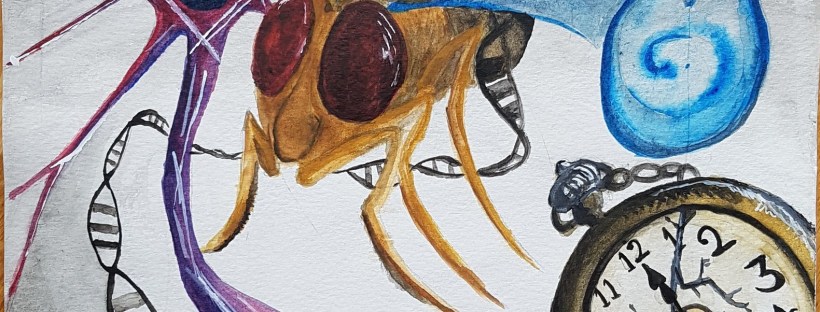
By Jo Sharpe Fruit flies: it’s hard to find a soft spot for these irritating insects, but stick them in a lab and they take on a new importance. The fruit fly, Drosophila melanogaster, is more often associated with an overflowing kitchen bin than a lab, but in fact it's a great model for understanding … Continue reading Understanding Dementia on the Fly
Finding new ways to investigate inflammation in the brain
By Dr Chris Hoyle The human brain is the most complicated computer on the planet. Its hardware consists of an intricate concoction of cells that convert countless electrical and chemical signals every second into each thought, decision or action that we make. Our brains are the reason we have sent rockets to the moon and … Continue reading Finding new ways to investigate inflammation in the brain
Cognition in schizophrenia: a missing piece of the therapeutic puzzle
Originally posted on PLOS ECR by Jessica Brown What kind of mental image springs to mind upon reading the word ‘schizophrenia’? Many envisage an individual locked in a dark institution, constantly plagued by non-existent voices and vivid hallucinations. Even as a final year BSc Biology student with a neuroscience research placement under my belt, I … Continue reading Cognition in schizophrenia: a missing piece of the therapeutic puzzle