By Lucy Hulme
When the UK went into lockdown in March 2020, the government introduced novel social distancing measures to reduce the spread of COVID-19. These new measures emphasised the stay-at-home order. However, maternity care is one of many health services that cannot be wholly delivered online. Maternity care had to adapt.
The new social distancing measures acknowledged that people would need to leave their homes for maternity care. So, the Royal College of Obstetricians and Gynaecologists and the Royal College of Midwives began collaborating to create guidance for how to continue antenatal and postnatal services in the evolving COVID-19 pandemic. This guidance aimed to continue providing usual eight antenatal consultations but with an emphasis on remote consultations via telephone or video calling where possible, home monitoring if equipment was available for distribution, and constant evaluation of mental wellbeing. For postnatal care, the guidance advised that appointments, scans, and any other investigations that required an in-person consultation should be provided in a single visit and involve the minimum required staff. Other changes include the necessity of staff to wear personal protective equipment (PPE) and the banning of birth partners during antenatal appointments and even the labour.
Research into how parents have experienced these changes to antenatal and postnatal care has begun into other countries. In Iran, researchers found that pregnant women are feeling anxious and described themselves as being obsessed with hygiene and constantly checking the news media. Mortazavi and Ghardashi have described this as a disruption to the tranquillity of daily life for the pregnant Iranian women. Similarly in Italy, work by Ravaldi revealed that pregnant women are feeling more fearful about their pregnancy in the year 2020. Usually, pregnant women are always somewhat fearful of pregnancy, but the usual feelings of fear are balanced by positive feelings of joy and happiness of having a new baby. This year, pregnant women feel fearful in a way that is associated with negative feelings of restriction and loneliness.
However, there is not yet any research into how parents have experienced antenatal and postnatal care in the UK. There remains a gap in the emerging COVID-19 literature about how UK parents have, and still are, experiencing antenatal and postnatal care during this pandemic. Therefore, we believe qualitative exploration is necessary to begin identifying these parents’ unique experiences in the UK.
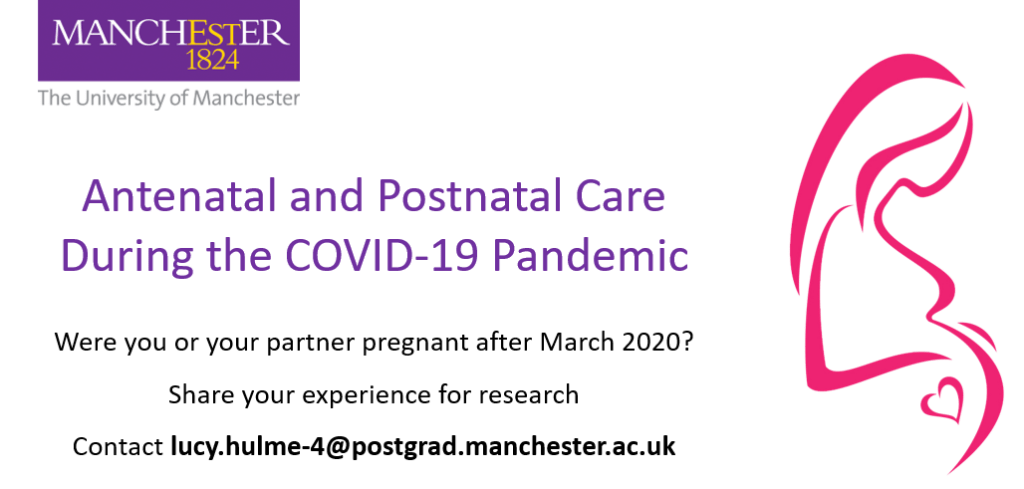
Our project aims to explore what are UK parents’ experiences of antenatal and postnatal care during the COVID-19 pandemic. We are recruiting anyone aged 18 and over who either has been pregnant themselves, or their partner has been pregnant, after March 23rd 2020 and therefore have experienced antenatal and / or postnatal care in the UK during the COVID-19 pandemic.
We plan to set up online interviews with parents to learn more about their experiences. This will include:
- How has COVID-19 affected their antenatal and postnatal care?
- How parents’ felt about their antenatal and postnatal care/
- If they have experienced maternity care before the COVID-19 pandemic, and how does it compare?
- What has been the role of the partner?
- What advice would parents’ give to other expecting parents going through antenatal and postnatal care during the COVID-19 pandemic?
- What would parents’ change about their own antenatal and postnatal care, if anything?
These interviews will help fill the gap in the literature and bring to light how parents in the UK are experiencing antenatal and postnatal care during the COVID-19 pandemic.
Were you or your partner pregnant after March 2020? We want to hear from you!
If you would like to take part or find out more, please email lucy.hulme-4@postgrad.manchester.ac.uk
Discover more from Research Hive
Subscribe to get the latest posts sent to your email.

