
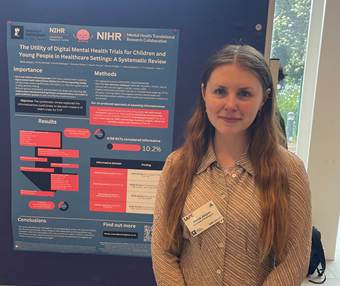
Author: Alexia Jeayes // Editors: Emily Barrett & Federica Spaggiari
We often assume that more research in digital mental health means better answers… But what if it isn’t giving us the answers we need?
The evidence researchers generate must be relevant, transparent, and shaped by the needs of everyone who relies on it to make decisions. This article explores why some research falls short and how we can build stronger, more useful evidence for digital mental health.

Why good evidence matters
Digital mental health tools, like apps, online therapies, and games, are becoming more common, especially for children and young people. They offer an exciting possibility of improving access to support that is flexible and scalable.
But there’s a problem.
Even though many studies (including clinical trials, which are often considered the “gold standard”) are carried out, a large proportion of these are not seen as useful or informative for real-world decision-making. For example, a clinical trial might show that an app “works” under ideal conditions but not tell us whether people would actually use it, or whether services could realistically deliver it.
This creates a disconnect:
- Researchers produce evidence
- Clinicians, services, and policymakers rely on it
- Service users are affected by the decisions
But the evidence doesn’t always answer the questions these groups actually have.
What did our study explore?
In our recent study, we set out to better understand what makes digital mental health research informative; in other words, truly useful for decision-making.
We used a qualitative, collaborative approach, working with two key groups:
- Researchers with a range of expertise in youth digital mental health
- A diverse group of young people with lived experience of mental health difficulties and digital tools
This involved individual interviews with researchers and participatory workshops with young people. Instead of treating young people as passive participants, we actively involved them in discussing, shaping, and responding to the ideas emerging from the research. We asked both groups:
- What does an informative, or useful, clinical trial look like?
- What helps make a clinical trial useful or informative?
Importantly, the findings were not based on one group alone. We analysed researchers’ perspectives in depth and then compared and integrated these with the views of young people, allowing us to identify both shared priorities and important differences.
By bringing together academic expertise and lived experience, we were able to move beyond a purely technical definition of “good evidence” and develop a more holistic co-produced understanding, as one that reflects both scientific rigour and real-world relevance.
What actually counts as good evidence?
Across both groups, four key features were identified. An informative trial should:
1. Address the right questions
Trials need to focus on the questions that truly matter, to clinicians, services, young people and families, not just what is academically interesting.
For example:
- Does it reduce anxiety symptoms?
- Do young people actually use it?
- Who does it actually work for?
If a trial doesn’t answer the kinds of questions that matter to clinicians, services, and young people, it may not be helpful for decision-making.
2. Feasible to run and realistic to use
Research might look perfect on paper, but if it’s too complex, costly, or difficult to research, it won’t translate into practice.
Both researchers and young people highlighted the necessity of trials being realistic and manageable for participants, researchers, and services.
Examples of when research is feasible and realistic include:
- When a study tests an app in the same settings where it would be used (e.g. in schools)
- Result: findings are directly relevant to real-world use
- The intervention fits within existing resources (e.g. minimal staff support)
- Result: services can realistically adopt it
- Participation is manageable (e.g. remote delivery)
- Result: a wider and more representative group of young people can take part
3. Trustworthy and credible
Good evidence must be reliable and trustworthy. In our study, both researchers and young people highlighted the importance of credible, transparent, and methodologically sound research.
This includes things like:
- Using appropriate study designs and methods
- Reporting findings clearly and honestly
It also goes a step further. Trustworthy research means being able to follow the story of a trial from start to finish and see that everything lines up.
For example, a credible trial should have a clear and consistent record:
- The study protocol (what researchers planned to do) is publicly available
- The trial is registered in advance, outlining its aims, outcomes, and methods
- The final published paper matches what was originally planned
These are important because they help avoid problems like only publishing ‘positive’ results, changing the outcomes after the study starts, and analysing the data in an unusual way to get a different result.
When these elements are in place, decision-makers can feel more confident that the findings reflect what actually happened, rather than a partial or biased picture.
In short, trustworthy evidence is not just about what is found, but about how openly and consistently the research has been conducted and reported.
4. Accessible and safe
Young people emphasised the need for trials to feel accessible, inclusive, and safe. This goes beyond technical quality and includes:
- Using plain-language information sheets, explaining the study well to potential participants
- Involving end-users in designing the study
- Checking for any negative effects (e.g., increased distress)
- Considering ways to mitigate power dynamics between researchers and participants
This perspective highlights that evidence isn’t just about numbers but also about people and their experiences, and making sure that the research is relevant and safe for real people.
Why perspectives differ and why that matters
One interesting finding was that researchers and young people didn’t always prioritise the same things.
- Researchers focused more on rigour, feasibility, and logistics
- Young people highlighted inclusivity, accessibility, and power dynamics
Both perspectives are essential. If we only prioritise one, we risk producing evidence that is not useful. Bringing these perspectives together is key to producing evidence that is both credible and useful.
What helps make trials more useful?
The study also identified three wider factors that influence whether trials are truly useful or informative:
- Partner involvement: working with stakeholders, including end-users, clinicians, and researchers throughout the research process
- Capacity and resources: having the time, skills and infrastructure to deliver high-quality research
- Wider context: external factors like funding, policy priorities, and service pressures. Making sure that findings are grounded in real-world conditions.
These remind us that improving evidence is also about the wider research system and environment.
A simple way to think about it: “FAIR” trials
Building on these insights, we describe trials that are truly decision ready as being:
| F | Feasible: Trials must be realistic and doable in real-world settings. |
| A | Actionable: Trials should answer real-world questions that can lead to meaningful change and are informed by stakeholder needs. |
| I | Inclusive: Trials are inclusive, safe, and equitable, and shaped by diverse perspectives. |
| R | Reliable: Trials produce reliable and trustworthy evidence, with rigorous methods, validated outcomes, transparent reporting, and credible development. |
Together, these ideas reflect what we mean by good evidence in digital mental health.
What’s next?
This work is part of a wider effort to reduce research waste and improve how evidence is used in practice.
Clinical trials require a significant amount of funding, time, and effort. Improving the utility of research is not just a methodological issue but an ethical issue too. By working more closely with those who use and are affected by research, we can:
- Produce more relevant findings
- Improve equity and accessibility
- Support better, more informed decisions
We’re excited to continue this work and will share our full findings soon.
In the meantime, we invite others to reflect on what counts as “good evidence” in their field of research? And how can we raise the bar together?
Jeayes A, Babbage C, Sprange K, Hall CL. Understanding trial informativeness in digital mental health: perspectives from researchers and lived experience experts. Trials [Internet]. 2026 Mar 18;27(1). Available from: https://link.springer.com/article/10.1186/s13063-026-09610-w
Discover more from Research Hive
Subscribe to get the latest posts sent to your email.

